










 Motortopia Staff
.
April 02, 2026
.
News
Motortopia Staff
.
April 02, 2026
.
News
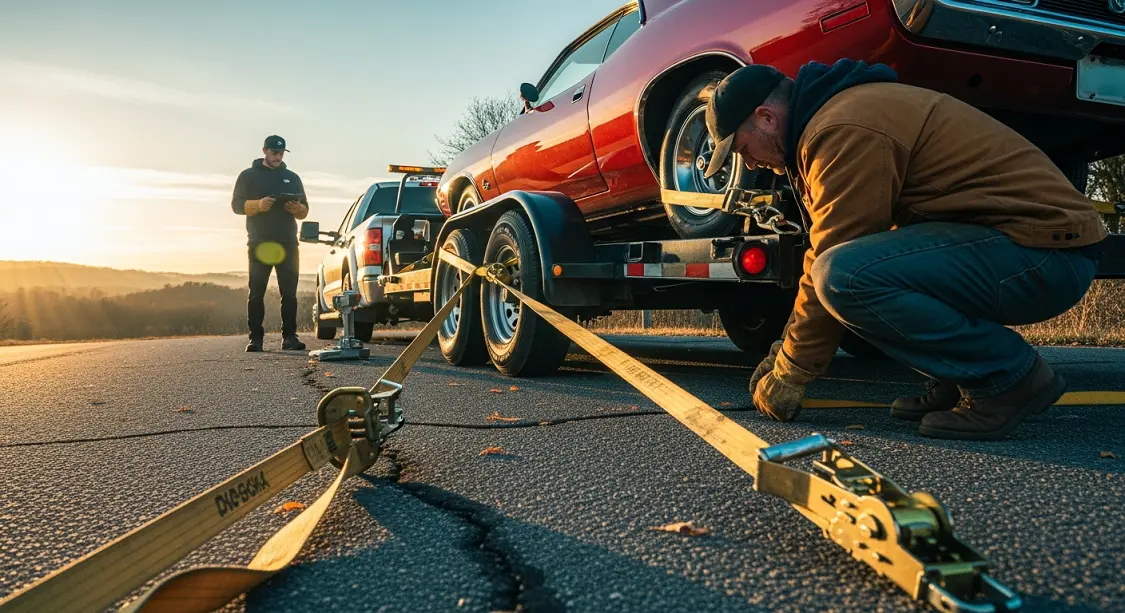
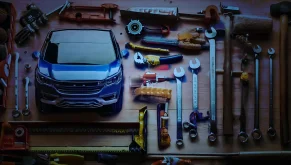
Image generated by Gemini
You just handed over a stack of cash for a gutted ’88 C10, but the hardest part of the project is right now—getting the heavy, rolling shell back to your garage in one piece. Hauling thousands of pounds of metal requires much more than just a rusty drop hitch and blind confidence. Public highways are incredibly unforgiving, and the margin for error when dragging a dead chassis is practically zero. The grim reality is that 40,901 people died in motor vehicle crashes in 2023. We are going to walk through balancing your load, checking your gear, and adjusting your driving habits so you can safely tow your project car without becoming another highway statistic.
Getting your new build home safely means accepting that a trailer completely changes how your vehicle handles. Every time you turn the wheel or hit the brakes, that dead weight fights violently against your tow rig. Since almost 93% of car crashes are caused by driver error, the responsibility falls squarely on your shoulders. A successful haul is entirely dependent on your prep work before the tires ever hit the pavement. Taking the time to dial in your setup right now is the only way to protect your new investment.
Just because a vehicle can physically drag a trailer doesn’t mean it is legally homologated or structurally safe for the job. You might think your daily driver has enough torque, but popular cars like a Honda Civic or Toyota Corolla are explicitly not homologated for heavy towing. Putting a heavy load on a light-duty unibody chassis will warp the frame and destroy the transmission. You have to step up to a proper 1/2-ton or 3/4-ton rig that is specifically built to handle 3+ tons of rolling steel. A war-ready tow rig gives you the braking power and suspension stiffness required to maintain absolute control over the load.
Trying to cheat the system with a modern compact crossover is a massive mistake that will cost you dearly. For example, attempting to tow with a 2024+ Chevy Trax can severely damage the vehicle and instantly void your warranty. Manufacturers engineer these small vehicles for commuting, not for dragging a steel car hauler across state lines. Even if you use a capable truck, you must confirm its digital safety systems are fully operational.
| Vehicle Class | Example | Max Tow Capacity | Pros | Cons
|
| 3/4 Ton Diesel Truck | Ram 2500 | 15,000+ lbs | Massive braking power, stiff frame, exhaust brake | Expensive to maintain, rough daily ride |
| Mid-Size SUV | Ford Explorer | 5,000 – 5,600 lbs | Comfortable, good for light open trailers | Not suited for enclosed trailers or heavy classic cars |
| Compact Crossover | Chevy Trax | Not Homologated | Great fuel economy for daily driving | Towing voids warranty, structural damage risk |
When I was hauling my OBS Ford across the country, a tail-heavy load almost put my truck into a ditch, terrifyingly demonstrating the “tail wagging the dog” effect. This happens when you ignore the 10-15% rule for tongue weight, which dictates that a fraction of the total trailer weight must press down on the hitch. Before you even think about loading the chassis, you must inspect the towbar for tightness, cracks, or serious rusting. A compromised hitch receiver can literally snap under the immense stress of a bouncing car trailer. Securing the load properly starts with a rock-solid mechanical connection between your truck and the hauler.
The pre-tow prep work continues with testing your 7-pin electrical connections to ensure your trailer brakes and lights work perfectly. You also need to verify that your trailer tire pressures are set to their specific heavy-load rating. Furthermore, it is a critical legal and safety requirement to fit suitable towing mirrors on both sides and adjust them properly. Trying to blindly change lanes with a massive car hauler blocking your rearview is a recipe for disaster. Visibility and electrical reliability are the absolute bedrock of a safe towing operation.
Piloting a heavy haul completely shifts your vehicle’s momentum, effectively doubling your standard braking distances on the highway. You can no longer rely on quick steering inputs or aggressive braking to get out of trouble. To maintain control and prevent vicious trailer sway, safety authorities strongly recommend keeping your speed strictly between 50 and 60 mph on highways. Just because your diesel truck has the horsepower to do 80 mph up a grade doesn’t mean your trailer tires can survive the heat. Upgrading your suspension with parts from our Hellwig Sway Bar Upgrade guide for a 2018 Ram 1500 can also dramatically improve your high-speed stability.
If trailer sway does start shaking your rig, whatever you do, DO NOT slam on the brakes. Instead, let off the gas, hold the steering wheel straight, and gently apply the manual trailer brake override to pull the setup back in line. Overcorrecting a swaying trailer will violently throw your tow vehicle into the adjacent lane or oncoming traffic. This is a fatal mistake, as head-on collisions account for roughly 10.9% of all motor vehicle fatalities. Staying calm and letting the trailer brakes do the work is the only reliable way to regain control.
Even if you flawlessly balance your tongue weight and drive defensively, other negligent drivers can cause a catastrophic multi-vehicle accident. A blown-out trailer tire or a reckless commuter cutting you off can turn your dream project into a twisted pile of scrap metal. These violent highway traffic crashes are devastatingly common, resulting in an unbelievable $1.4 trillion in societal and economic harm in 2019. The sheer mass of a truck and a loaded car hauler makes any collision exponentially more destructive. When things go sideways at highway speeds, the physical and financial fallout is immediate and overwhelming.
The financial ruin following a major towing accident is staggering for everyone involved in the wreck. Medical facilities across the country treated 5.1 million motor vehicle accident injuries in 2023 at a total cost of $513.8 billion. If you suffer a severe head impact during a rollover, the lifetime medical expenses for a traumatic brain injury can quickly exceed $3 million. Back and neck injuries are just as financially crippling for automotive builders who rely on their physical health. In fact, the first year of medical expenses for a spinal cord injury averages a massive $1.079 million.
Dealing with the insurance company on your own after a severe highway wreck is a guaranteed losing battle. Adjusters will fight tooth and nail to minimize your personal injury payouts, and they certainly will not properly value your custom project car. This is exactly where having specialized high-impact collision lawyers makes all the difference for your financial recovery. The team at 844 See Mike brings proven, hardcore experience handling complex multi-vehicle collisions across Illinois. They know exactly how to untangle bad-faith insurance disputes and fight relentlessly for full vehicle damage recovery.
When you are dealing with the immense emotional toll of a crash, you need an advocate who understands the stakes. Your priority should be healing from your injuries, not arguing with claims adjusters over the value of a classic chassis. Having a relentless legal advocate in your corner ensures you aren’t left holding the bag for someone else’s mistake. Protect your health and your automotive investment by trusting professionals who fight for the compensation you rightfully deserve.
All the extra time spent checking straps, balancing tongue weight, and driving defensively pays off the moment you back that project car into your driveway. Making it home safely means you get to enjoy the build, rather than becoming part of the 5.1 million motor vehicle accident injuries reported nationwide. Proper preparation turns a highly stressful transport mission into a smooth, uneventful highway cruise. You can finally unhook the safety chains, drop the ramps, and roll your new canvas into the workspace. Now, the real fun of wrenching, cutting, and fabricating finally begins.
We know you are eager to fire up the welder, but remember that a safe haul sets the tone for the whole build process. Take pride in your towing setup just as much as you take pride in the custom vehicle you are building. All modifications and vehicle work are performed at your own risk. Always use appropriate safety gear, follow manufacturer instructions for tools and equipment, and consult a professional if you are unsure about any step. Motortopia is not liable for any damage or injury resulting from the information provided in this article.
News
Track Your Ride: The Ultimate Guide to Installing GPS Trackers on Custom Car Builds Key Takeaways Always plan carefully before installing GPS trackers on custom… Continue reading
Motortopia Staff . July 23, 2025
News
Sedans Lost the Status War. SUVs Won It. Here’s Why Image Source: https://unsplash.com/photos/man-in-suit-walks-past-black-suvs-in-parking-lot-KDA9cnw8jZw Back at the end of the last century, status cars in the… Continue reading
Motortopia Staff . May 04, 2026

News
Most motorists in St. Louis, Missouri, prepare for flat tires, dead batteries, and heavy rain. Far fewer think through the legal strain that can follow… Continue reading
Motortopia Staff . June 09, 2026

Drag Racer
The Formative Years IN PART 1 OF OUR TRIBUTE TO THE 50TH ANNIVERSARY OF THE FUNNY CAR, DRAG RACING HISTORIAN “200-MPH” DAVE WALLACE EXPLAINED THE… Continue reading
Bob McClurg . August 18, 2026
News
Alcohol-impaired driving resulted in traffic fatalities for a total of 11,904 people in 2024, according to the National Highway Traffic Safety Administration (NHTSA), where offenders… Continue reading
Motortopia Staff . July 16, 2026

News
Print-through (telegraphing) happens when your adhesive sinks, shrinks, or exotherms hard enough that the show surface reflects what’s going on underneath. If you’re bonding carbon… Continue reading
Motortopia Staff . September 30, 2025


The Sparks Show
Sevierville, TN
Dino's Git-Down
State Farm Stadium, Glendale, AZ
Dino's Git-Down
State Farm Stadium
Goodguys 36th Autumn Get-Together
Alameda County Fairgrounds 4501 Pleasanton Avenue, Pleasanton, CA 94566
Goodguys 29th Speedway Motors Southwest Nationals
WestWorld of Scottsdale 16601 North Pima Road, Scottsdale, AZ 85260
We use cookies to enhance your browsing experience, serve personalized ads or content, and analyze our traffic. By clicking "Accept All", you consent to our use of cookies. Visit our Cookie Policy for more info.


 Please wait...
Share Link