










 JIM ALLEN
.
September 01, 2026
.
Dodge
JIM ALLEN
.
September 01, 2026
.
Dodge
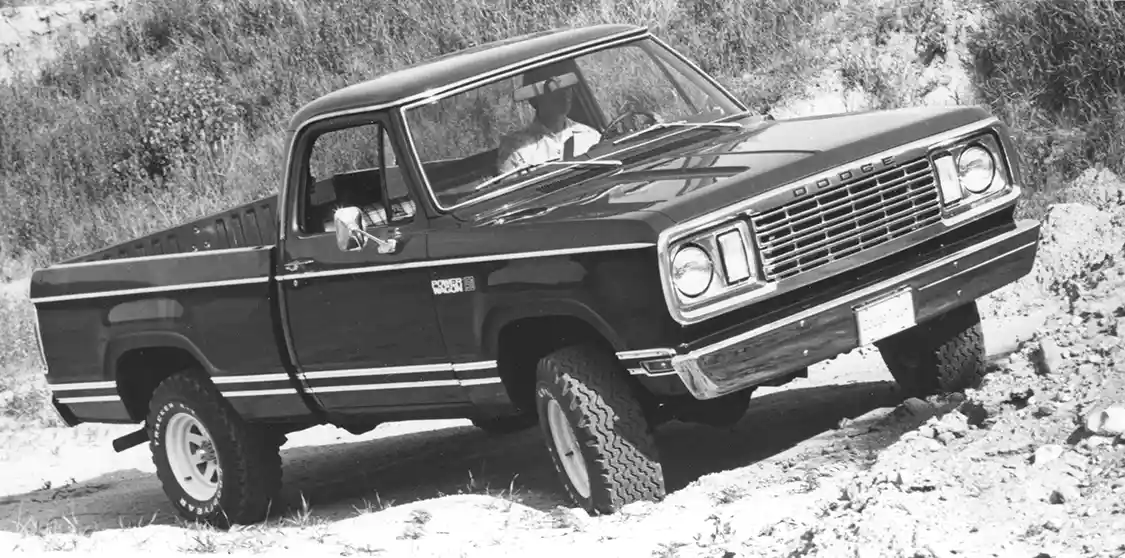
The immense popularity of the Cummins-powered Dodge/Ram trucks over the last 25 years has tended to overshadow Dodge’s earlier forays into diesel-powered light trucks. And Chrysler Corporation is probably a little grateful for that because the early results weren’t pretty. It isn’t exactly a secret that Dodge introduced a diesel option in the ’78-79 light truck line, but they were so utterly forgettable that most people have done just that.
Towards the end of the ’70s, the Big Three were well into their gas-crunch-beatdown by the import manufacturers and looking for any way to catch up. The development of diesel-powered light trucks as a way towards better fuel economy was a natural progression that became accelerated by higher and higher gas prices and a floor of fuel efficient imports.
It isn’t exactly clear when a struggling 1970s Chrysler Corporation decided to take the first steps into diesel-powered light trucks. We know they dabbled back in the early ’60s with Perkins-powered W-300s, but according to period magazines, the ’78 Dodge diesel pickups began development in 1975 or 1976 using Mitsubishi diesels.
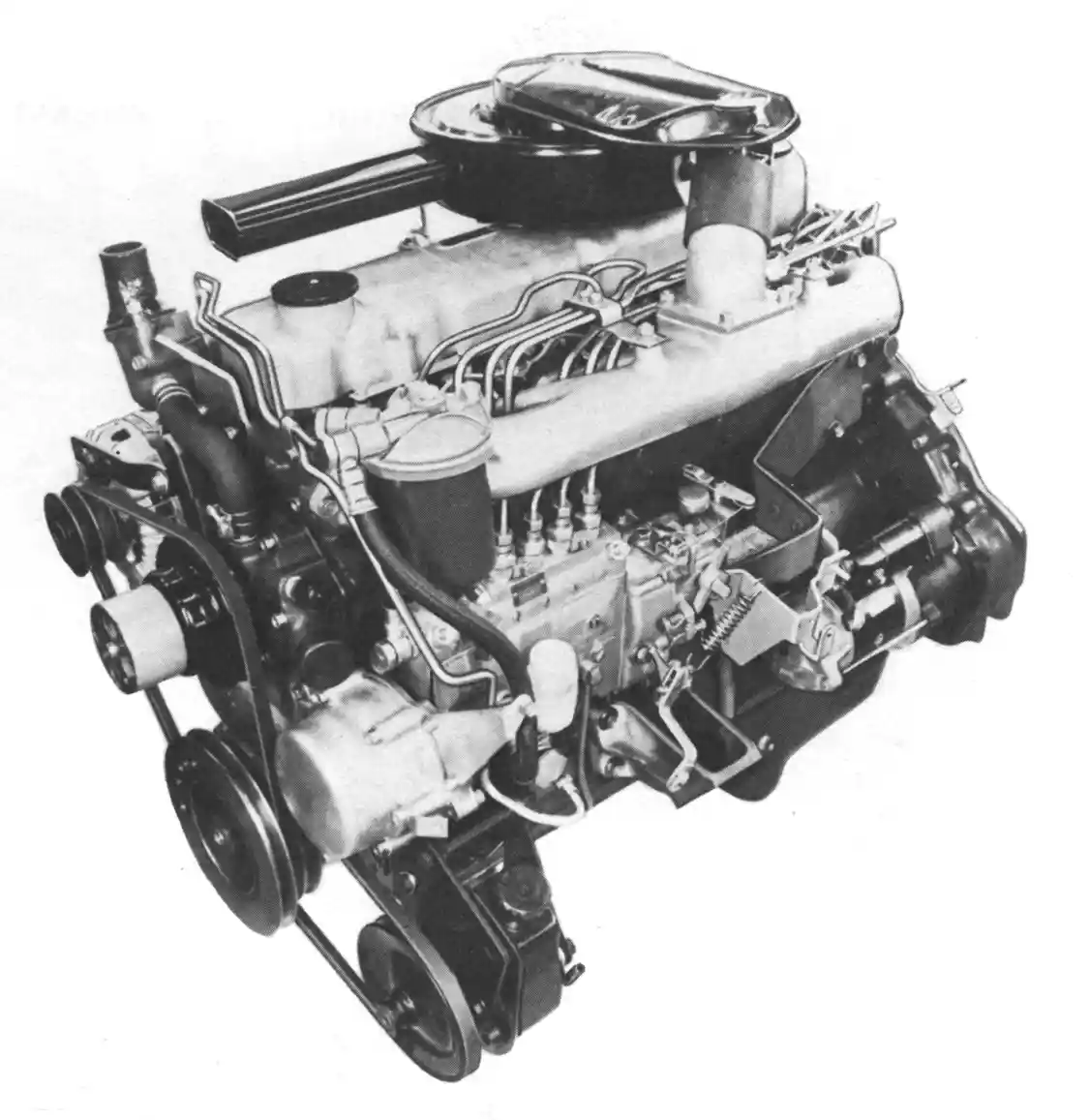
Since 1970, Chrysler had been in a joint venture agreement with Mitsubishi Motor Corporation (MMC) of Japan. That agreement brought us the MMC-built Dodge Colt starting in 1971 and the Dodge and Plymouth D-50 compact trucks of 1979, to name just two of many rebadged Mitsu products sold by Chrysler. Among the other items being built by Mitsubishi was a line of industrial diesels, and it was from this line that the engine was chosen for the Dodge trucks.
The Mitsubishi 6DR50A was one of the newest in the line of Mitsubishi diesels for that day, the 6DR5 family. It had a smaller brother in the 4DR5 four-cylinder, which shared the same 3.62-inch bore and 3.94-inch stroke as well as many design features and small parts interchanges. The seven-main six was naturally aspirated and rated for 103-105 hp at 3,700 rpm and 168 lb/ft of torque at 2,200. Yep, that makes the 160 hp and 400 lb/ft of the first generation Dodge Ram Cummins diesels look like powerhouses. Even the lowly 225-cid slant-six, the base engine in the Dodge truck lines, beat the Mitsu diesel for power and torque.
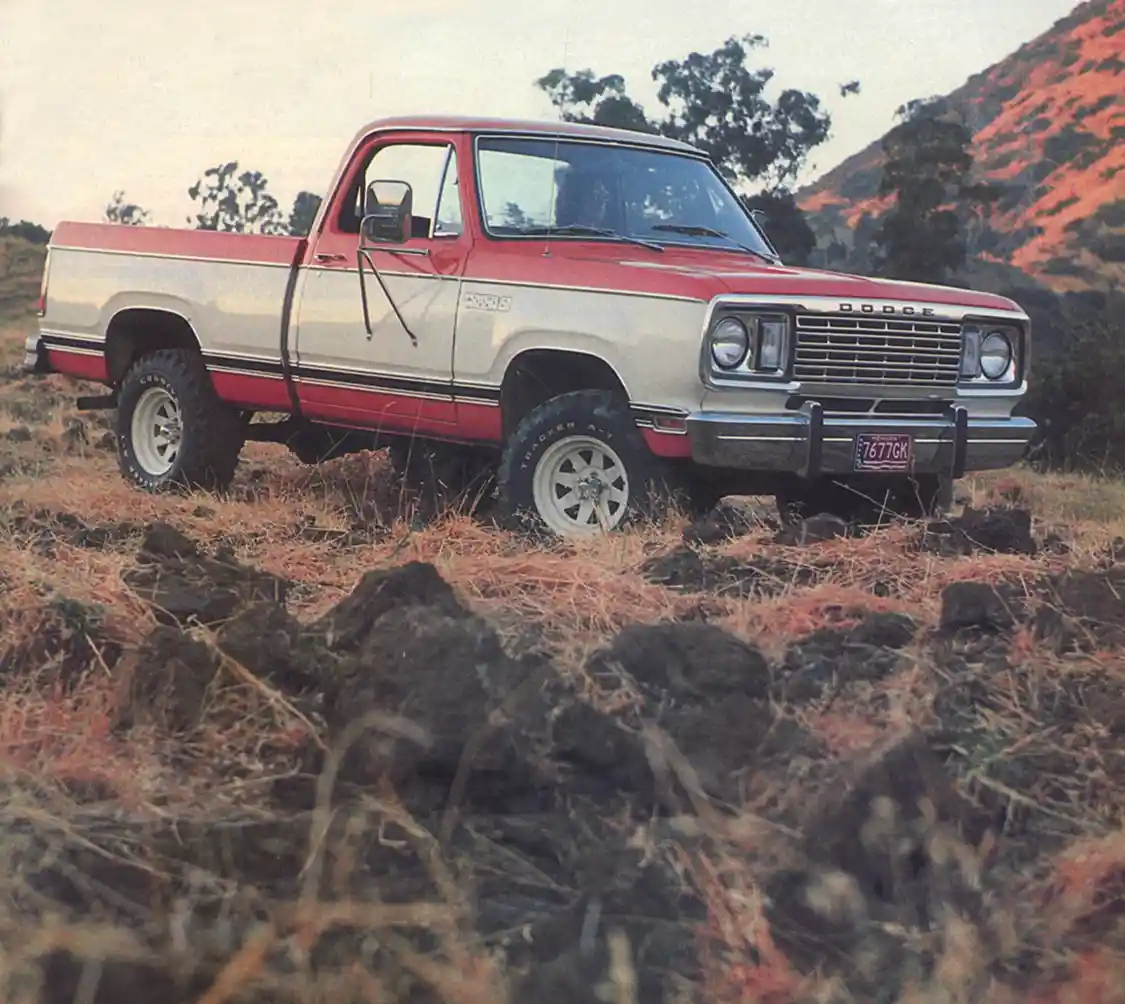
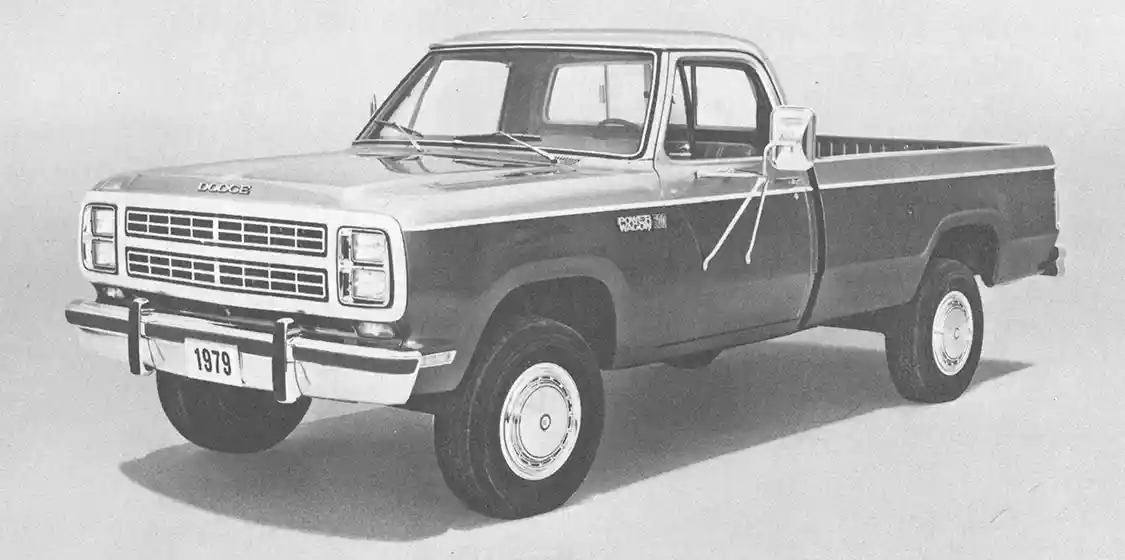
The diesel was optional in both the half-and three-quarter-ton lines and in both two-and four-wheel drive models, long or short wheelbase, regular cab or Club Cab. Most of the trim packages were available with the diesel option, including the Custom, Adventurer and Adventurer SE, as well as the Luxury Equipment (LE) package. Air conditioning was available, as well as tilt steering, bucket seats and the lurid stripe packages of the day. You couldn’t order a diesel in a Crew Cab truck, any D or W-300 one-ton, with the Camper Special, Sno-Commander or Trailer Special packages. The Mitsu diesel was also an option in Dodge vans for ’78 and ’79, and came standard with an overdrive manual transmission. The diesel was not available in California.
The transmission options boiled down to two, a standard NP435 wide ratio four-speed manual or an optional 727 Loadflite automatic. The half-ton W150 came with 3.55:1 axle ratios with no options other than a limited slip and the three-quarter-ton W200 came with 4.10:1 gears. If you opted for a 4×4, you got the NP-203 full-time transfer case. The half-tons used the semi-float Chrysler 9.25 rear axles and the three-quarter tons used the full-float Dana 60. Dana 44s were used up front in both trucks.
The diesel option, which cost $1,600 for the ’78 model year, had some mandatory extras, including a 10-inch clutch for the manuals, power steering, 63-amp alternator, dual 70AH batteries, oil pressure gauge, block heater, hydro-boost power brakes and heavier front springs.
The magazines were not exactly kind to the Dodge diesels. The notable lack of power, onerous starting procedure and lots of smoke all elicited negative comments. Pickup, Van and 4WD magazine (PV4) listed a 25.8-second 0-60 time with a 24.9-second quarter-mile at 58 mph and a top speed of 75 mph on a W150. On the plus side, they noted the great torque characteristics on the trail and fuel economy. PV4 reported 20.1 mpg in mixed driving. The base engine in the truck lineup, the gas 225-cid slant-six (115 hp and 175 lb/ft), could crank out 0-60 runs in the 15-second range and could deliver about 15 mpg.
Low power is the common theme for all the early diesel introductions. Start off with an anemic, NA diesel and then wonder why people didn’t buy them in bushel baskets. A turbo version of this engine wasn’t available, but BAE Turbo Systems offered a kit in ’78 and ‘’79 ($1,095) for the Mitsu diesels that boosted power by nearly 40 percent. It bumped rear wheel power from 70 to 96 hp at 3,000 rpm. That would roughly be 145 hp at the fly-wheel. Flywheel torque would roughly be 240 lb/ft at 2,200 rpm. The 0-60 times for the 4×2, four-speed test truck dropped from 22 seconds to 18.4 with. Even then, the diesel credo was true, “there’s no excuse for a naturally aspirated diesel.”
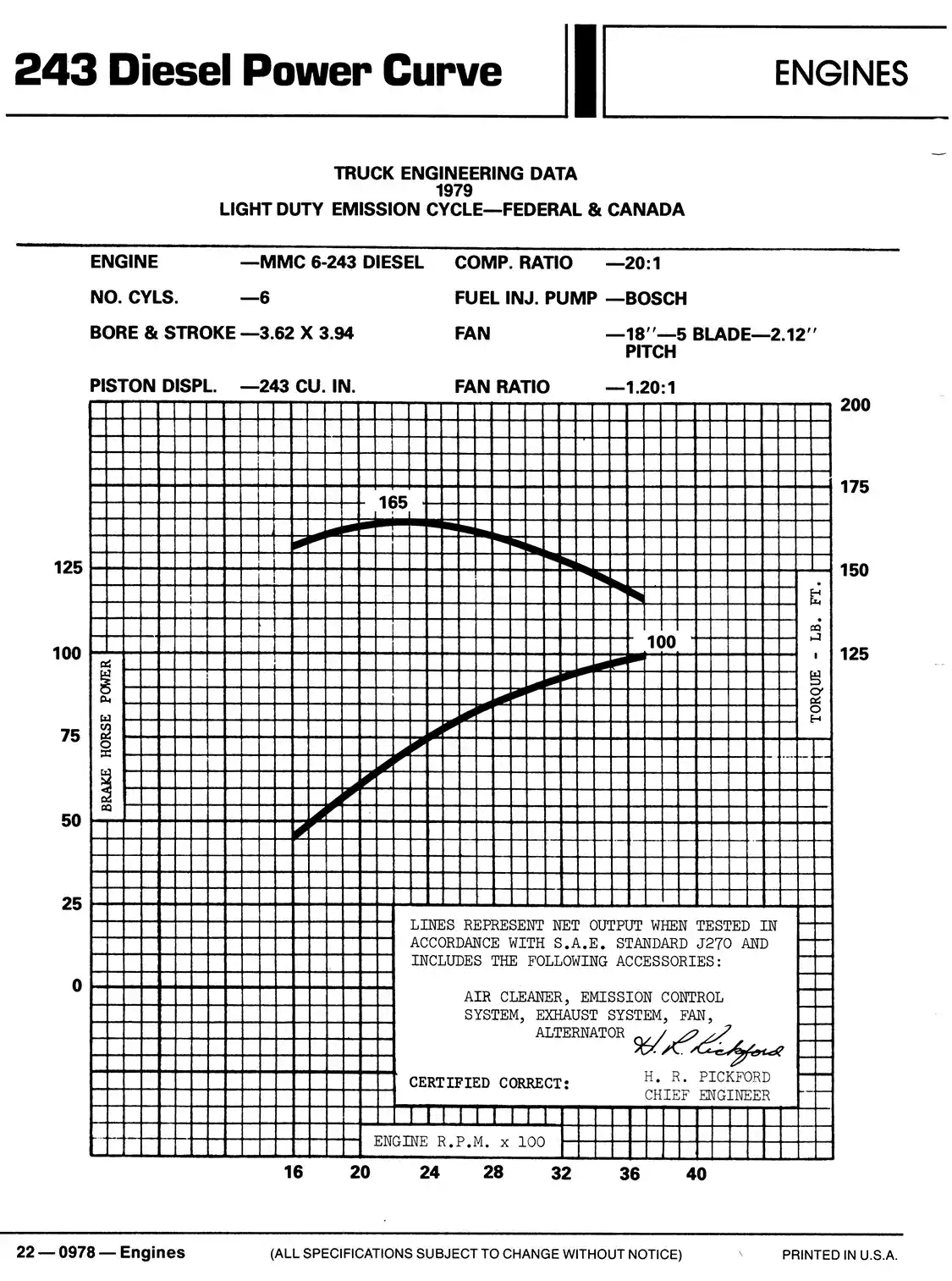
The diesel quietly faded away in the ’79 model year. Some dealers had them in stock into 1980. Of course, hindsight is always 20/20, but you could say this was a monumental waste of effort. If we armchair QB this, we’d have advised them to either start with a large-displacement NA diesel or a turbo diesel. The former idea is what propelled Ford to the forefront of the early diesel wars, but Dodge eventually redeemed itself in ’89 with the turbo Cummins and then became the brand to beat.
The ’78-79 Dodge diesels are not common these days. We have not been able to get a read on how many were produced. One source lists 2,835 units. That remains unverified but sounds about right. They turn up occasionally but seldom bring any money over or above a similar gas truck. They’re a curiosity more than a collector’s item and parts for the Mitsubishi 6DR50A are incredibly difficult to get. UDBG
Chrysler Corporation had another diesel engine available in the 1970s that might have been a contender for the Dodge truck line. Since the 1920s, Chrysler Corporation operated a Marine and Industrial Engine branch, which built marineized or industrial- ized versions of their automotive and truck powerplants. When they had gaps in the product line, they sometimes supplemented with outside manufacturers. Since they built no diesel engine in-house, that’s often where you found the outside products.
Such was the case when Chrysler formed an exclusive distribution agreement with Nissan in 1969 for the SD-33, six-cylinder diesel, among a number of other Nissan diesels. This compact, versatile engine was being used all over the world in just about every operation imaginable. Among the more mundane was automotive use and it could be found in Nissan medium duty trucks all over Asia and in the Nissan Patrol.
After the Chrysler agreement, the Nissan became best known as the diesel option for the ’76-80 International Harvester Scout II and Scout-based Traveler SUV and Terra pickups. In the early ’80s, it was also offered in the Jeep CJ-10 and the later CJ-10A flightline tugs. The to the late ’70s, the SD-33s sold here for automotive use were often wearing “Chrysler Nissan” badging, painted yellow and designated CN6-33. That’s how many of them are seen in the early days of the Scout applications. Later Scout engines, built after the breakup, are seen in Nissan Blue.
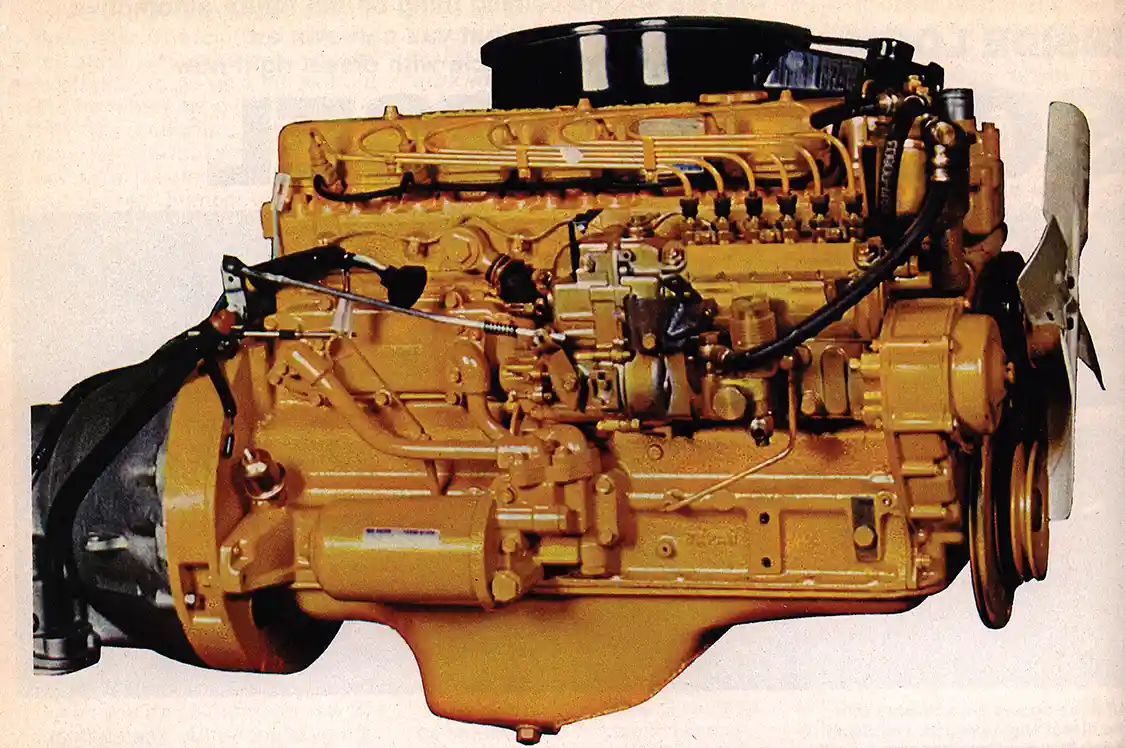
So how did the Nissan SD 33 compare to the Mitsu 6DR50A? It had less displacement, 198ci vs 243. Interestingly, it shared the same 3.94-inch stroke as the Mitsu but had a much smaller 3.27-inch bore. It made less power and torque too, a mere 81 hp and 138 lb/ft. Considering the Mitsu was already a slug, it isn’t hard to see why the Nissan wasn’t a viable performance option. Or was it?
In ’79, Nissan developed a turbocharged version, the SD-33T. It made 101 hp and 175 lb/ft with the addition of tuning, beefing and 6.5-psi boost from the AiResearch turbo. That was about even with the NA Mitsu. The SD-33T saw use in late ’79 and ’80 model year Scouts and it was a big improvement in performance for those trucks. In fact, performance was considered “acceptable” and the turbo diesel Scouts may have become a popular option. Too bad IH pulled the plug on the Scout after the 1980 mode year.
Sometime in the ’76-77 timeframe, the Chrysler/Nissan deal fell apart. From what little could be found on that, it seems Chrysler’s financial death spiral was more the cause of this than any issue with Nissan or the market for industrial engines. Over the time of the agreement, a lot of Chrysler Nissan diesels were sold… predominantly, it seems, as marine engines.
So was the Nissan SD-33 a viable alternative to the Mitsubishi 6DR50A? Probably not. Me mere 100 hp in a full sized truck is bad enough. Twenty ponies and 30 lbs-ft less is far worse. The SD-33T… maybe… but, again, a turbocharged Mitsubishi was the better answer. But that didn’t happen from the factory. Plus, the sheets were torn be tween Nissan and Chrysler by that time and the relationship between Mitsubishi and Chrysler was very strong.
ENGINE: Inline Diesel Six, Mitsubishi 6DR50A
POWER (hp): 103 @ 3,700 rpm
TORQUE (lb/ft): 168 @ 2,200 rpm
BORE & STROKE (in.): 3.62 x 3.94
COMP. RATIO: 20:1
TRANSMISSION: Four-speed manual, NP435 (std)
Three-speed auto, LF 727 (opt)
TRANSFER CASE: Two-speed, NP-203
FRONT AXLE: Two-speed, NP-203
REAR AXLE Chrysler 9.25 semi-float
AXLE RATIOS: 3.55:1
TIRES: L78-15-B
7.00-15 M+S
10x15LT-B
WHEELBASE (IN.): 115 or 131 in
CURB WEIGHT (LBS.): 5,000 (115-in. WB)
FUEL CAPACITY (GAL.): 18
MSRP: $10,151 (well equipped Adventurer SE)
Events
Trucks, Trends, and More Trucks! The 2024 SEMA Show once again proved why it’s the premier stage for innovation, creativity, and craftsmanship in the automotive… Continue reading
Chris Hamilton . May 16, 2025
Drive Online
At SEMA 2023, automotive enthusiasts and industry leaders gathered under the neon lights of Las Vegas to witness a spectacle of innovation and passion. Among… Continue reading
Nicole Hamilton . November 09, 2023
Diesel World
Take a closer look at the next step in Dieselworld Mag’s editorial build If you’ve been around for a while (or not) you’ve probably seen… Continue reading
Tucker Harris . March 07, 2025
Drag Racer
Holley’s LS Fest West Since the inception of Holley’s LS Fest, motorheads west of the Rockies have been pleading with the hosts to bring their… Continue reading
Pete Ward . September 24, 2026
Chevrolet
AS SEEN IN OUR STREET TRUCKS MARCH 2026 ISSUE – Buy Now! A 20-Year Odyssey of Grit and Custom Glory JOSH Cyrus, a VP of… Continue reading
PHIL GORDAN . April 20, 2026
Feature Stories
The Vegas Bronco that Stole the Show In the realm of custom creations, where automotive dreams become reality, lies the mighty weapon of a Bronco… Continue reading
Jerome Andre . September 27, 2023

The Sparks Show
Sevierville, TN
Dino's Git-Down
State Farm Stadium, Glendale, AZ
Dino's Git-Down
State Farm Stadium
Goodguys 36th Autumn Get-Together
Alameda County Fairgrounds 4501 Pleasanton Avenue, Pleasanton, CA 94566
Goodguys 29th Speedway Motors Southwest Nationals
WestWorld of Scottsdale 16601 North Pima Road, Scottsdale, AZ 85260
We use cookies to enhance your browsing experience, serve personalized ads or content, and analyze our traffic. By clicking "Accept All", you consent to our use of cookies. Visit our Cookie Policy for more info.


 Please wait...
Share Link