










 Motortopia Staff
.
July 30, 2026
.
Industry Updates
Motortopia Staff
.
July 30, 2026
.
Industry Updates
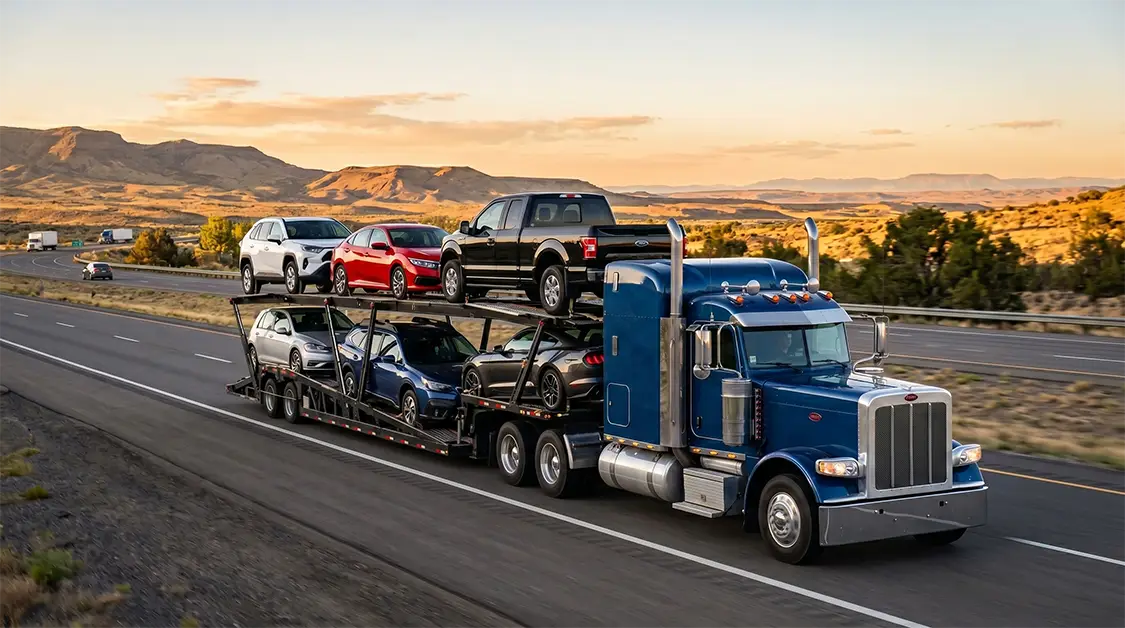
There’s a moment in every cross-country move when you look at the driveway and do the math. Two vehicles, one route, 2,700 miles, and somebody has to be at the new place by Thursday to sign a lease. Or maybe there’s no move at all; maybe you won an auction for a ’72 Chevelle in Sacramento and you live in Charlotte. Either way, driving it yourself means days on the road, money for food, gas, and hotels, and many hundreds of miles of wear on a vehicle you may care about quite a bit.
Shipping it is often the better option. So what do you need to know? And what does it take to ensure a smooth experience rather than a stressful one?
A cross-country shipment has two phases, and it’s easy to make the mistake of only planning for one of them.
The first phase is the pickup window. When you book, you don’t get an exact pickup hour the way you might with a furniture delivery. You get a window, usually 1 to 5 days, while the company matches your vehicle with a carrier already running your direction. A truck hauling 8 or 9 cars from the Northeast to Southern California is threading together pickups across hundreds of miles, and your car is one stop on that route.
The second phase is transit itself. Coast to coast, figure about 7 to 10 days on the truck. Shorter cross-country legs, say Chicago to Phoenix, are often closer to 5 to 7 days. Weather, traffic, and mandatory driver rest hours all affect the number, which is why reputable companies quote ranges instead of promising a date and a time.
Add the two phases together and a realistic planning number for a coast-to-coast shipment is roughly 2 weeks, door to door. And while it might be faster, planning around the faster case is how people end up in a bind.
For a long-haul route, get your booking in 2 to 3 weeks before your ideal pickup date. Earlier booking means more carriers can see your shipment while their routes are still flexible, which translates to a better price and a tighter pickup window. Booking 3 days out on a 2,700-mile lane is possible, but you’ll pay expedited rates for the privilege, and your options shrink to whoever happens to have a slot.
Season matters more than most people expect. January and February bring the snowbird rush, when demand out of the Northeast and Midwest toward Florida and Arizona spikes and prices go up with it. Summer is peak relocation season everywhere, with June through August running busy on nearly every long route. Winter adds a routing wrinkle too: carriers crossing the Rockies or the northern plains have to build in weather margin, so a December shipment on a northern lane deserves extra calendar padding. If your dates are flexible, shipping in the shoulder months, spring and fall, tends to get you the best combination of price and speed.
Most companies you’ll get quotes from are brokers, meaning they arrange the shipment and contract a carrier, the trucking company whose driver actually hauls your vehicle. On a cross-country route, the broker’s carrier network is what matters most. A deep network means plenty of trucks already running your route and a quick match. A thin one means your car sits while somebody works the phones.
That’s worth asking about directly before you book: how many carriers does the company work with, and are they vetted for FMCSA compliance and insurance? If you can’t get a straight answer, that tells you something.
Open transport, the standard double-decker rig, handles the vast majority of cross-country shipments without drama, daily drivers included. Ten days of highway exposure means your car arrives dusty, and that’s about the extent of it.
Enclosed makes sense when the vehicle justifies it: a classic, a show build, an exotic car, or anything with paint or value you’d rather not test against 2,700 miles of weather and road grit. Expect a premium of roughly 30 to 50% to ship in an enclosed carrier, and slightly longer lead times, since there are fewer carriers and their schedules fill faster.
The most common cross-country mistake isn’t picking the wrong company, it’s scheduling the car like it’s a package. A few habits that save real headaches:
Plan to arrive before your car does, not after. Someone has to be at the destination to meet the driver, fully inspect the vehicle, and sign off on its condition. If you can’t be there, find a trusted person in advance and make sure the shipping company knows who it is.
Assume a gap without your vehicle on at least one end. If the car ships before you fly out, or lands after you arrive, you’ll need a few days of rides or a rental. Budget for it now instead of discovering it at midnight in a new city.
Keep your phone handy during the pickup window. Drivers coordinate directly, and an unanswered call can bump you down the route.
And before pickup: leave about a quarter tank of gas, pull out personal items and the toll transponder, photograph the car from every angle, in daylight, and note anything quirk. Ten minutes of prep protects you at delivery.
Sometimes it does. A carrier breaks down, weather closes a pass, a prior pickup runs long. What you want at that moment is a company that tells you, rather than one you have to chase. Before booking, look at how the company communicates: is there real tracking, do updates come to you automatically, can you reach a live person? On a 2-day shipment, poor communication is an annoyance. On a 10-day one, it’s the difference between a hiccup and a week of not knowing where your car is.
Coast-to-coast open transport for a standard vehicle generally runs $1,200 to $1,700, with enclosed, oversized vehicles, and peak-season timing pushing the price higher. Rather than guess, price your actual route. RoadRunner Auto Transport has been shipping vehicles for 30 years, quotes an all-inclusive price with no deposit required, and its quote calculator returns a real number for your specific route, vehicle, and dates in under a minute. Run it, compare it against another quote or two, and you’ll know quickly what your shipment should cost.
A cross-country shipment rewards the planner. Book early, know your two-phase timeline, match the trailer to the vehicle, and keep your phone on. Do that, and the hardest part of moving a car 2,700 miles is deciding what to listen to on the flight while somebody else does the driving.

Industry Updates
Harsh winds, bugs, dust, and debris may directly hit your face if you drive without a windshield. This proves that aside from giving you a… Continue reading
Motortopia Staff . October 15, 2024

Industry Updates
Advanced Driver Assistance Systems (ADAS) have transformed vehicle safety, integrating features like lane-keeping assistance, adaptive cruise control, and collision alerts. These systems rely on cameras… Continue reading
Motortopia Staff . June 24, 2025

Industry Updates
Ceramic coatings have revolutionized the car care industry, offering superior protection and an exceptional finish that lasts. But what do actual users have to say… Continue reading
Motortopia Staff . June 26, 2024
Industry Updates
Surrounded by all of downtown Los Angeles, the Petersen Automotive Museum stands out in its surroundings. A sculpted and modern architectural form wrapped in undulating… Continue reading
MICHAEL ECKERSON . March 04, 2023
Industry Updates
Performance Heads & Dyno Service Shows How to Make the Most of Chevrolet’s 427-Inch Big-Block When it comes to big-block power, Chevrolet has always ruled… Continue reading
JIM SMART . May 26, 2022

Feature Stories
We Pay Homage to One of the Best Anyone who’s been around classic trucks, hot rods, drag-racing, or motorsports in general from the ’80s on… Continue reading
Mike Alexander . September 01, 2023


Super Run 2026 Classic Car Show
Super Run 2026 Classic Car Show Casablanca Resort 950 West Mesquite Blvd Mesquite, NV 89027
Concours D'Elegance
Cobble Beach Resort 221 McLeese Dr, Kemble, ON N0H 1S0
Charity Car Show
Mesa Marketplace 10550 E. Baseline Rd, Mesa , Az 85209
CHICO CONCOURS Car Show
Silver Dollar Fairgrounds 2357 Fair Street, Chico, CA 95928
Goodguys 33rd Summit Racing Lone Star Nationals
Texas Motor Speedway 3545 Lone Star Circle
We use cookies to enhance your browsing experience, serve personalized ads or content, and analyze our traffic. By clicking "Accept All", you consent to our use of cookies. Visit our Cookie Policy for more info.


 Please wait...
Share Link