








 AARON GOLD
.
January 06, 2026
.
Feature Stories
AARON GOLD
.
January 06, 2026
.
Feature Stories
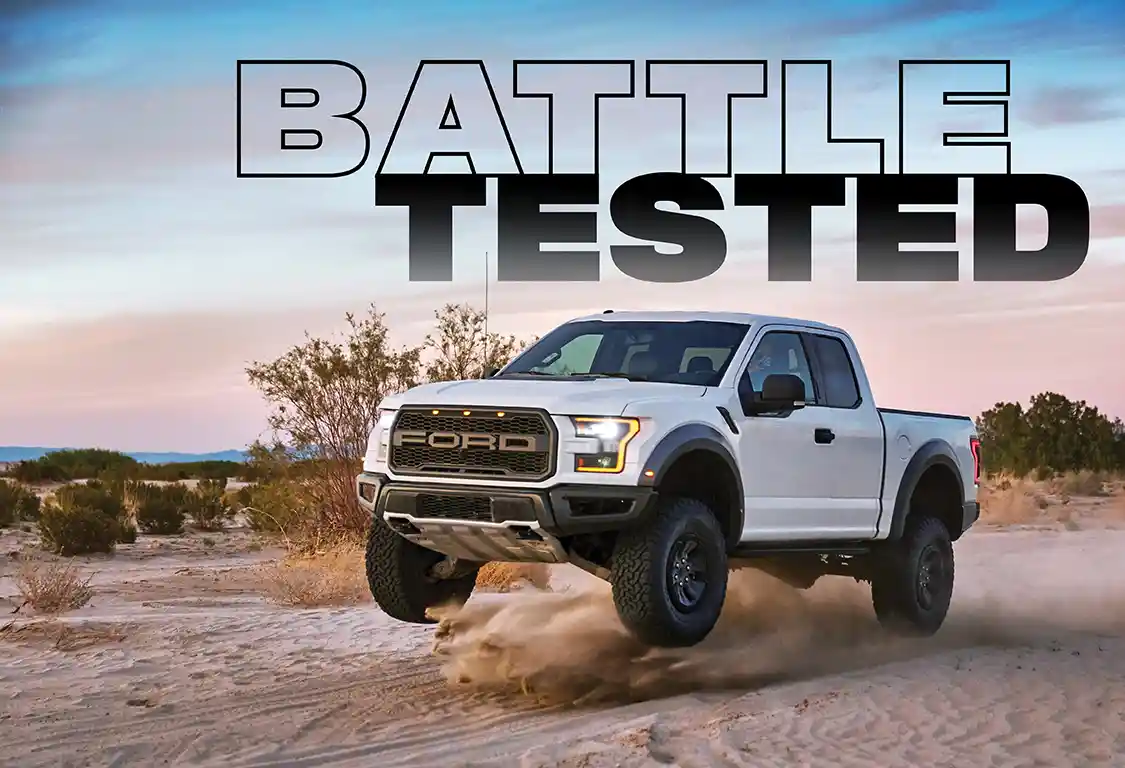
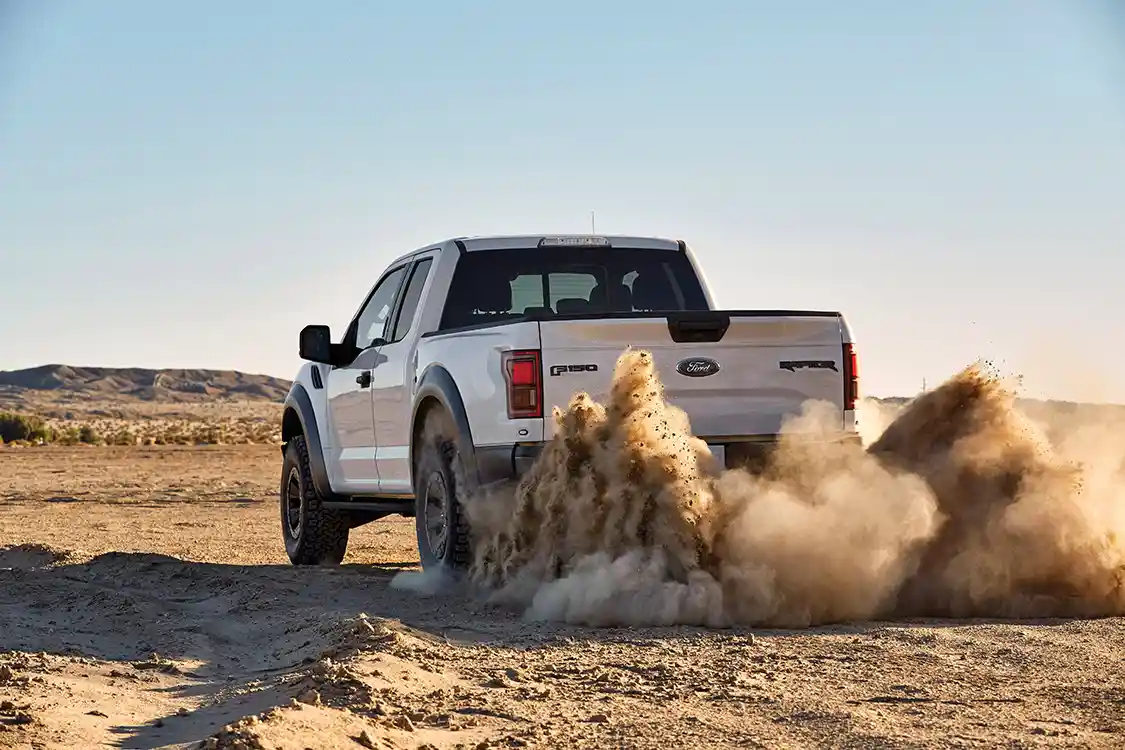
LET’S GET ONE THING OUT OF THE WAY: THE ALL-NEW F-150 RAPTOR IS ANYTHING BUT A STREET TRUCK. With nearly 2 feet of suspension travel, shocks as thick as Dwayne Johnson’s neck and tires heavy enough to stop bullets, the F-150 Raptor is what you buy if you want to win the Baja 1000 and are too lazy to build a truck of your own. It’ll conquer the kind of off-road terrain that most off-road pickups can crawl over, but it’ll do it at freeway speeds. The Raptor is, to put it mildly, about as off-road as an off-road truck can get.
That said, for those of us who stick to the blacktop, there’s still a lot to see, because a drive in the Raptor shows us the future of pickup performance.
We know there are a lot of readers who would rather go old school: a big-block V-8 fed by a four-barrel carburetor that drives the wheels through a heavy-duty automatic transmission. Those are the people we would most like to put behind the wheel of the new Raptor. We’d have them pop it into Sport mode and vigorously introduce the accelerator pedal to the floorboard, and we’d have our smartphone cameras poised and ready to record their reaction.
What happens should be no surprise: The Raptor leaps towards the horizon like a rabbit on amphetamines, with the 10-speed automatic pulling off hard shifts like a proper drag racer. Sixty miles per hour comes up in less than six seconds—we’re not using sophisticated timing hardware here, but rather the good ol’ “butt dyno”—and the noise is … well, it’s quite strange, actually, but we’ll talk more about that later. This is old-school speed delivered with modern technology, because virtually everything you experience when you floor the accelerator—the power, the shift feel, even the engine sounds— everything is managed by the Raptor’s electronics.
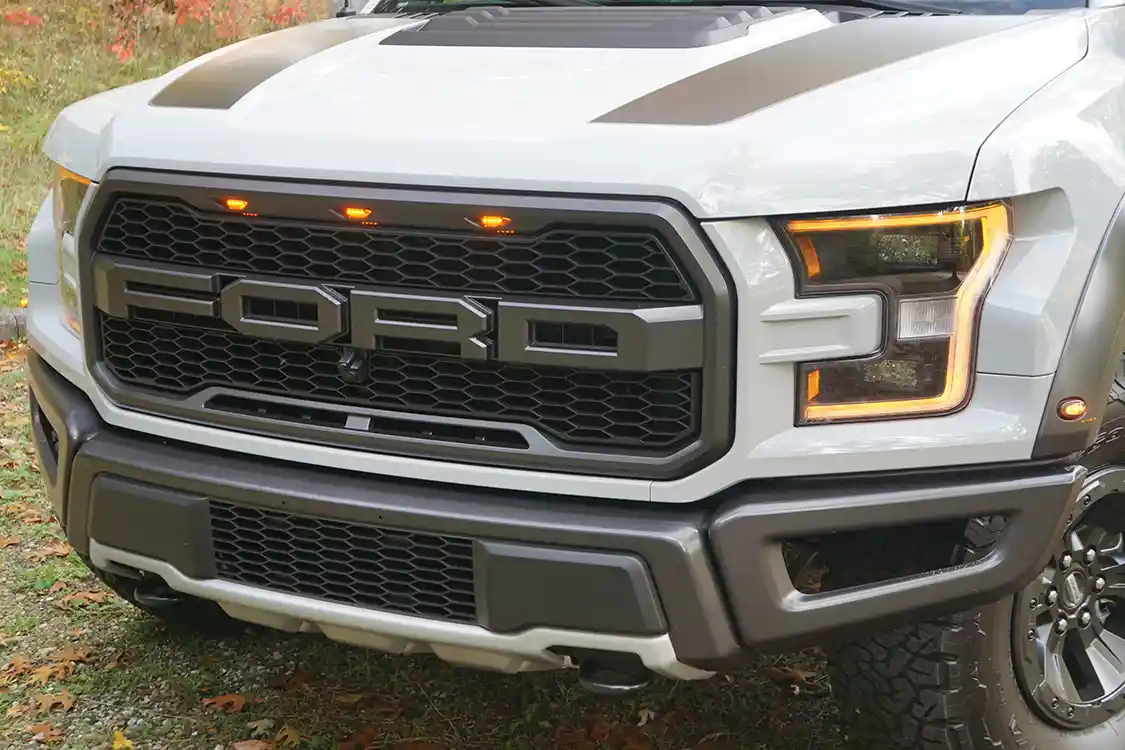
BEFORE we dive under the hood, let’s step back and take a look at the truck. Most of us probably have at least some passing familiarity with the old Raptor, and the new one shares the same look: wildly flared fenders, blacked-out grille and a big skid-plate under the chin. It’s even got the three LED clearance lights in the grille. The C-shaped headlights are the easiest way to tell the new Raptor from the old one.
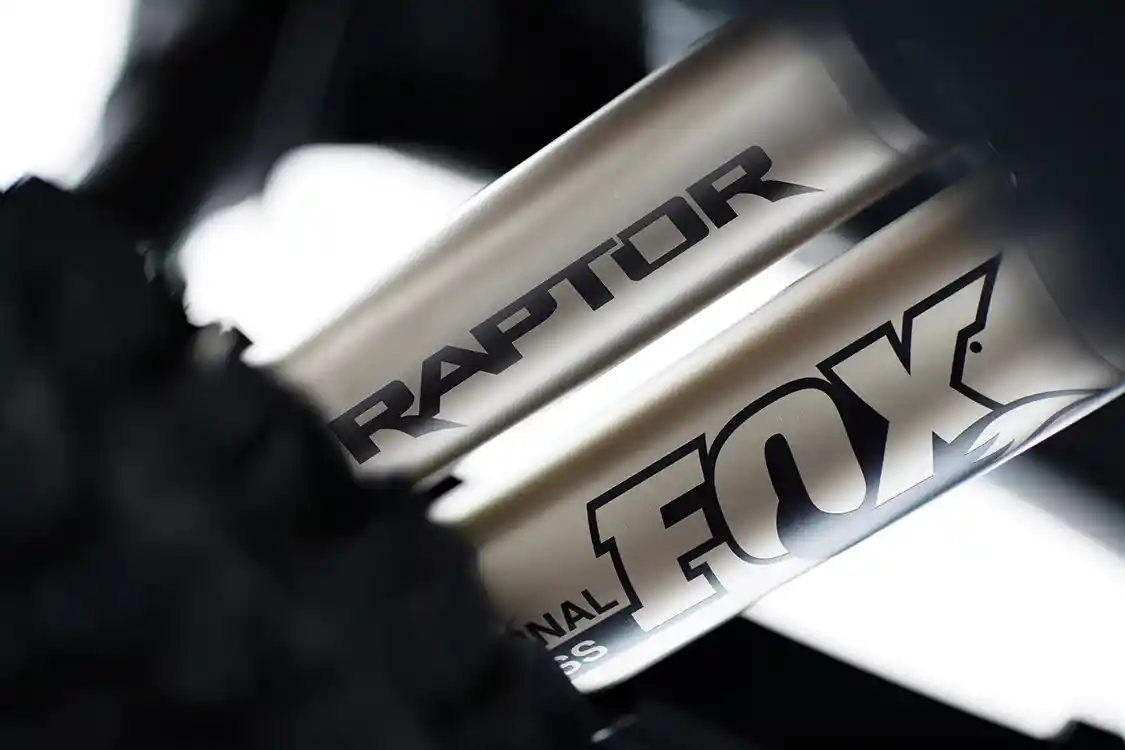
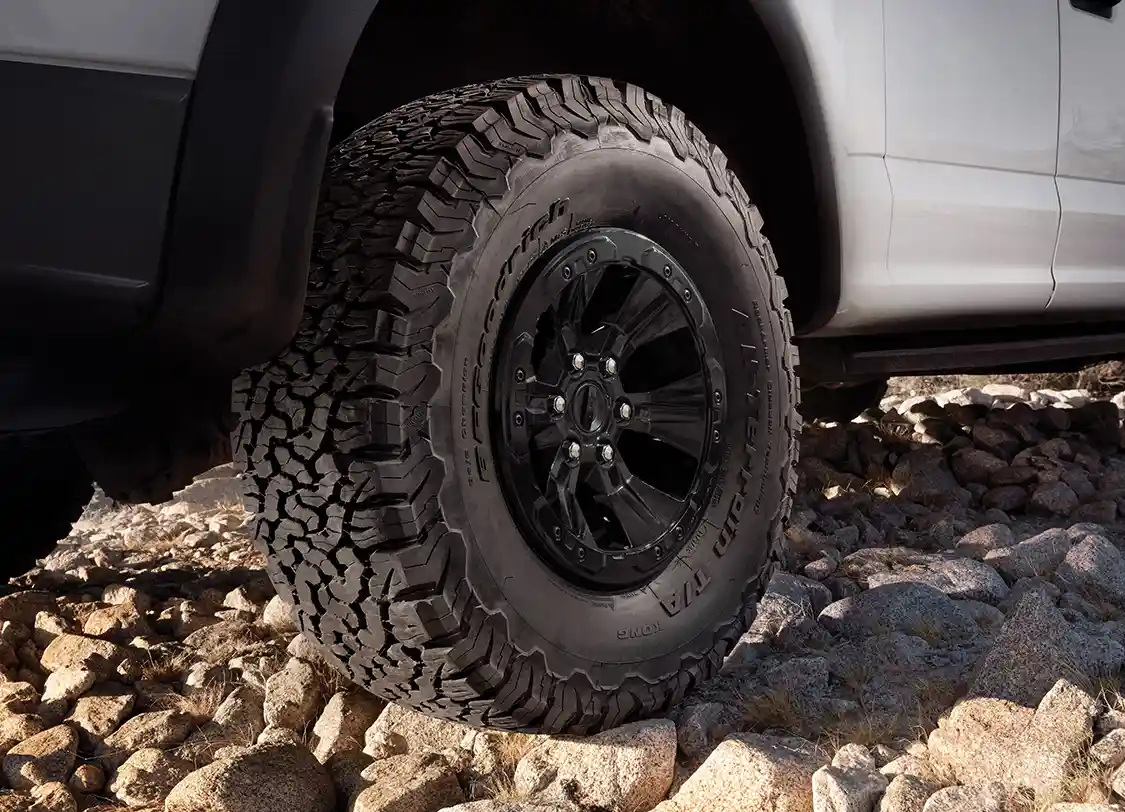
OBVIOUSLY, the Raptor’s mile- high stance is the exact opposite of the lowered look we like, but we have to admire the legitimacy—this is not an off-road poseur; it’s the real deal. The Raptor offers nearly 2 feet of wheel travel (13 inches in front and 13.9 inches out back), and the body and bumpers are shaped to increase its approach, departure and break-over angles. Like the old Raptor, the new one features factory-fit FOX shock absorbers, but they are larger, 3 inches in diameter as opposed to 2.5 inches in the old Raptor. They feature nine-stage bypass damping and integrated hydraulic bump stops. The BF Goodrich KO2 tires are designed for high- speed off-road travel, and the (optional) 17-inch forged alloy wheels do have actual bead-lock capability.
WHILE the chassis formula hasn’t changed much, pop open the Raptor’s hood and you’ll find a new breed of engine. The old Raptor used a version of Ford’s 6.2L gas V-8. The new Raptor has a V-6. Let us pause for a moment to turn this one over in our minds and remember the days when a six-cylinder full-size pickup was what your cheap-ass boss bought for the company fleet to keep his insurance rates low and prevent his employees from doing burnouts at job sites.
This V-6 is from Ford’s EcoBoost family, a line of twin-turbo engines introduced to provide V-8 power with closer-to-V-6 fuel economy. (Having towed heavy trailers in F-150s with both the 2.7 and 3.5L EcoBoost V-6s, we can attest to how well they work.) The Raptor’s engine is a 3.5L EcoBoost tuned up to 450 hp and 510 lb-ft of torque. That’s 75 hp and 40 lb-ft over the standard 3.5EB and, more importantly, 39 hp and 76 lb-ft more than the previous generation’s V-8-powered Raptor.
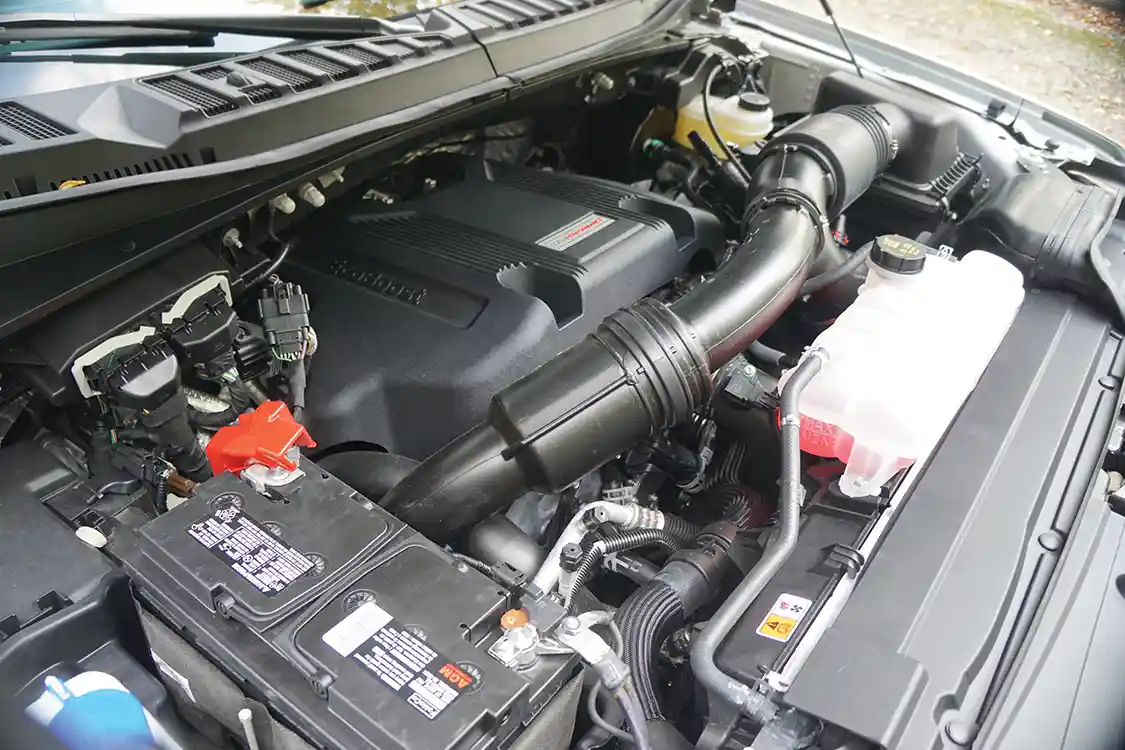
FOR the record, Ford did consider a V-8 for the new Raptor. Jamal Hameedi, chief program engineer for Ford Performance, told us that early on in the program, Ford built two Raptor test mules, one with a Coyote V-8 and one with an EcoBoost V-6.
“We decided the EcoBoost was the better solution for performance and drivability,” he said. “It outperformed the Coyote in every conceivable way. It wasn’t even close.”
Hameedi is of the opinion that the 3.5 EcoBoost could have gone into the Raptor as-is, but this being Ford’s “halo” truck, they needed halo performance, which would come by flowing more air through the engine—and that meant larger compressor wheels and electrically actuated wastegates for the turbochargers. The use of two turbochargers allows a true dual exhaust system, a rarity these days.
The power upgrades required beefing up the bottom end, with upgrades to the crank and bearings and a two-piece oil pan. The valvetrain was modified to reduce weight and friction losses. An electronically controlled variable- displacement oil pump also reduces parasitic power loss. The result is an engine that is not only powerful, but also compact and light weight.
“This engine blows away every competitor’s V- 8 in terms of its torque curve and peak power, and it’s massively lighter,” brags Hameedi. “You cannot do better for a torquey truck engine.”
And that light weight is key, because that’s another important aspect of the new Raptor. Like the rest of the F-150 lineup, the Raptor’s body and bed have been switched from steel to aluminum. Overall, the new Raptor is up to a quarter of a ton lighter than the outgoing truck, and Hameedi estimates that 150 pounds of that weight savings comes courtesy of the smaller engine.
BEHIND the engine is a new 10-speed automatic transmission, which gives a wider gear spread and a lower crawl ratio than the old Raptor’s six-speed (not to mention old-school three-speeds). And those hard shifts we talked about? Those are optional.
“The ratio steps between the gears are so small that 80% of the shifts are completely imperceptible,” Hameedi explains. “You may not go through all 10 gears. It’s like having a suite of gears from which the computer can pick the best ratio.”
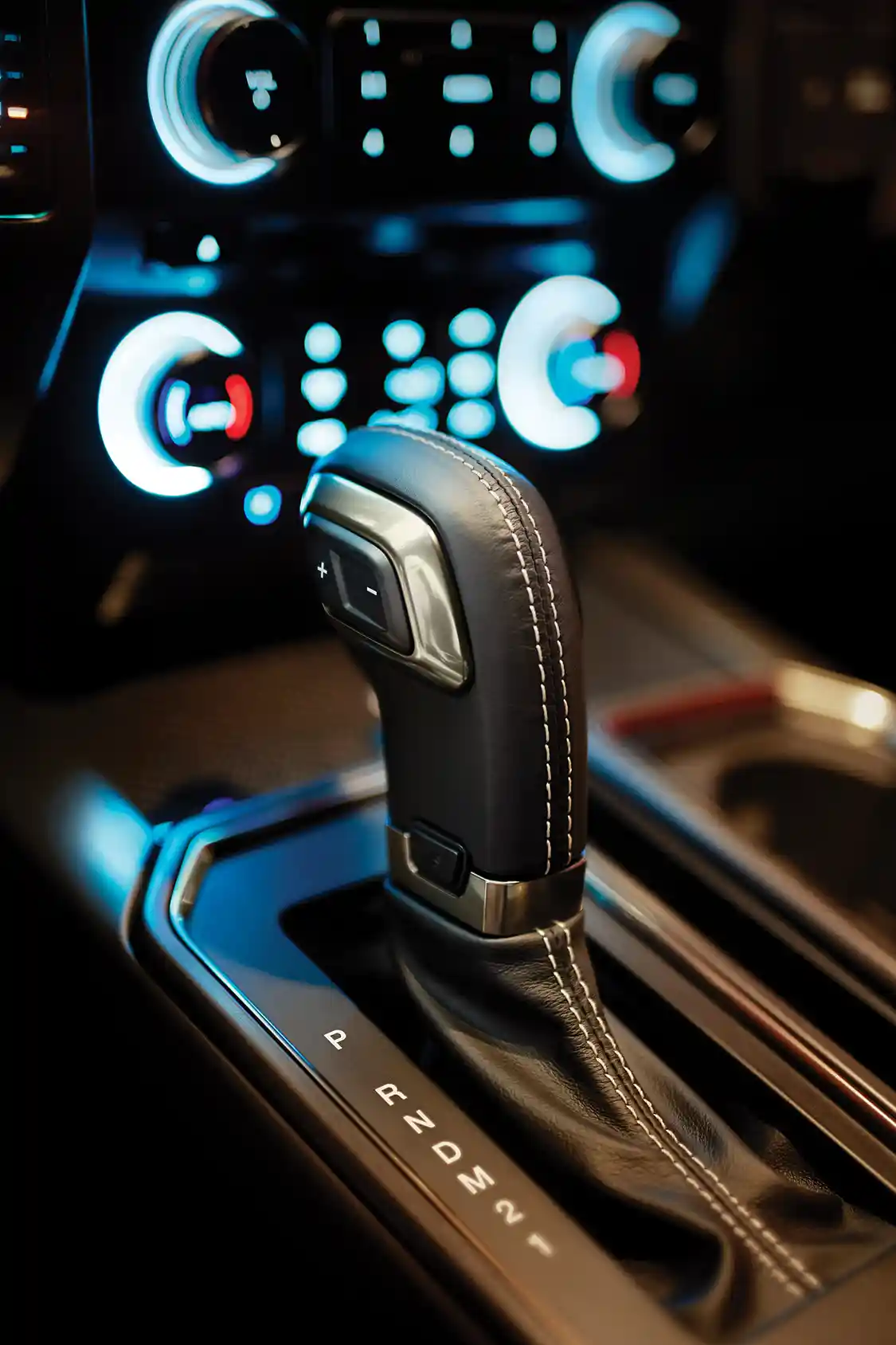
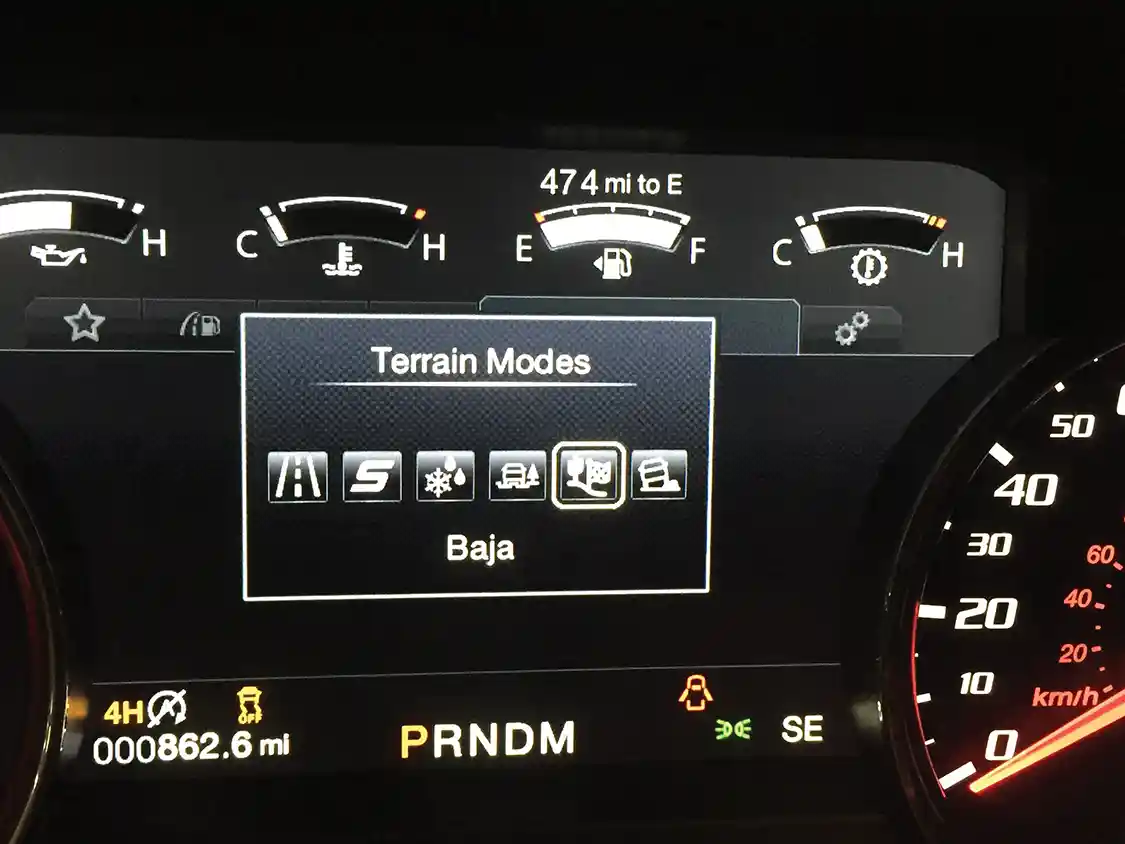
HE CONTINUES, “For Sport, Baja and Mud/Sand mode [those are three of the Raptor’s six driver-selectable drive modes; the others are Normal, Weather and Rock Crawl], we wanted a little bit of feel to the shift. The computer commands a higher trans fluid pressure, which fills the hydraulic circuits faster for a quicker shift.” Having experienced Sport mode for ourselves, we have to say that “a little bit of feel” is an understatement. The upshifts kick like a mule, and we love it.
Another cool bit of technology: In Baja mode, the Raptor employs what Ford calls an anti-lag strategy. When the driver lifts off the throttle—as one might do, when, say, the Raptor is airborne—the turbos can slow down, so that that the truck will experience turbo lag (a delay in power before the turbos speed up and start producing boost) when the driver gets back on the go-pedal. The anti-lag strategy keeps the turbos spooled up when the throttle is closed so that there’s no turbo lag when power is reapplied. How they do it is a patented procedure. Hameedi would only tell us it involves “certain camshaft and electronic throttle maneuvers.” Incidentally, Ford uses the same anti-lag system on the new GT.
AND what about the noise? Yeah, that’s engineered as well. The Raptor uses a noise-cancellation system to quiet the cabin, and essentially pipes in a V-8 soundtrack—or at least something that vaguely resembles a V-8 soundtrack. If you’re old enough to remember the raspy exhaust note that V-6-powered GM cars used to make back in the late-’80s and early-’90s, the Raptor will sound vaguely familiar (albeit somewhat louder). Of all the computer-enhanced sensations on the Raptor, the sound is the only one that really bothers us. Instead of trying to make this engine sound like something it isn’t, why not just open up the mufflers and let the V-6 sing its own song?
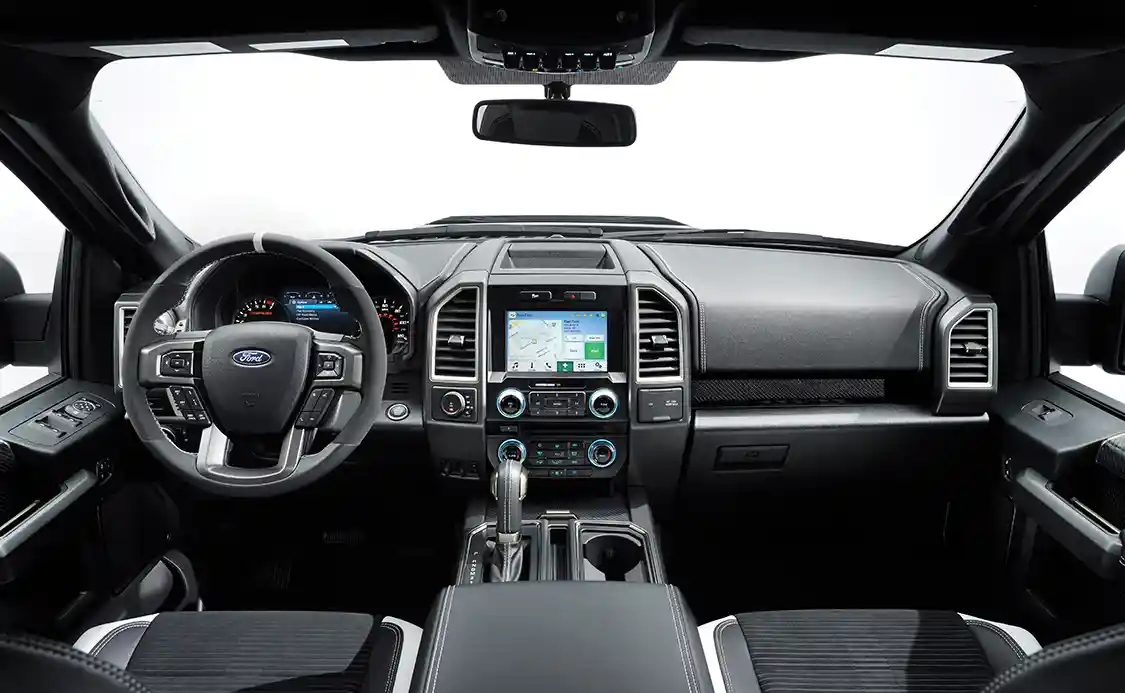

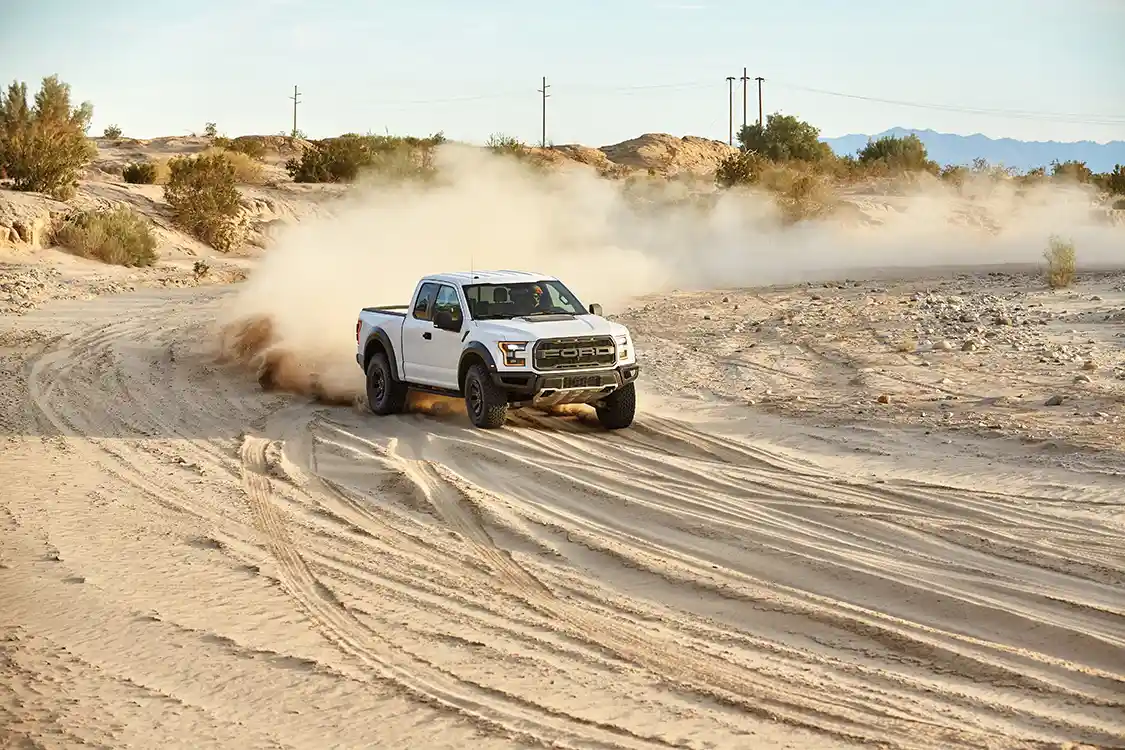
FORD is offering the Raptor in both extended- and crew-cab versions, with prices starting at $50,055 (including a $1,295 destination charge) and topping out at well over $71,000 with all of the factory- fit options. The F-150 Raptor is available now at Ford dealerships. If you buy one, be sure to bring a camera to capture all the fun you’re having along the way.


THANKS TO ALL THAT WEIGHT REDUCTION, THE RAPTOR HAS LESS MASS THAT NEEDS TO CHANGE DIRECTION. SOFT STEERING AND BODY ROLL ARE TO BE EXPECTED, BUT FOR WHAT IT IS, THE RAPTOR HAULS THROUGH THE CORNERS PRETTY WELL.”
WITH a suspension and tires tuned to jump sand dunes at 80 mph, the Raptor is pretty softly sprung, and that results in a comfortable on-road ride. Handling? It’s not as messy as you might think. Thanks to all that weight reduction, the Raptor has less mass that needs to change direction. Soft steering and body roll are to be expected, but for what it is, the Raptor hauls through the corners pretty well. We had a good time driving it. Who wouldn’t?

Diesel World
Florida, has a one-of-a-kind 2022 Ford F-250 that’s turning heads everywhere it goes. This beast of a Blue Oval isn’t just another pretty lifted truck.… Continue reading
Chris Hamilton . February 03, 2025
Chevrolet
Doing It Better the Second Time Being in the custom truck world on a daily basis, we see many different truck styles and calibers of… Continue reading
BRANDON BURRELL . November 21, 2023
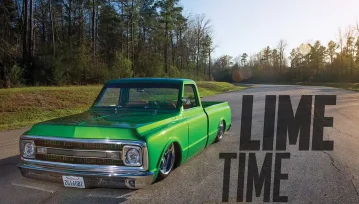
C10 Builders Guide
Perfecting The Modern Classic To most of us, our first “old” vehicle is more meaningful than our first-ever car or truck, unless that one just… Continue reading
John Mata Jr. . February 18, 2026
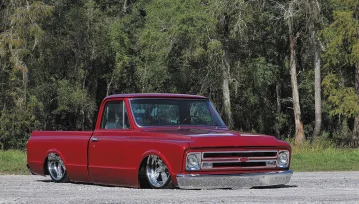
C10 Builders Guide
Chad Does it Again Having a name like Chad Shetsky has come with a lot of jokes and jabs but what isn’t a joking matter… Continue reading
PHIL GORDAN . October 16, 2023
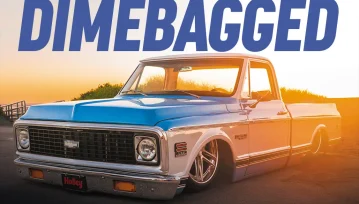
C10 Builders Guide
A Boosted C10 Built for the Streets and the Legacy Every now and then, a truck build comes along that hits differently. Not just because… Continue reading
Chris Hamilton . September 03, 2025
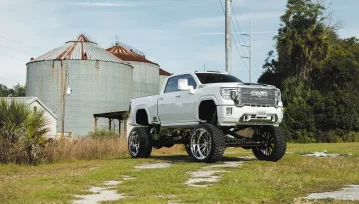
Diesel World
When Plan B Was Always Plan A Photos by Mach1Media There is no missing this towering 2023 GMC Denali 2500 HD. Whether it’s parked at… Continue reading
John Mata Jr. . April 03, 2024



Goodguys 11th Griot's Garage North Carolina Nationals Presented By Grundy Insurance
North Carolina State Fairgrounds 4285 Trinity Rd, Raleigh, NC 27607
Classic burgers 6th annual classic car show fundraiser
6525 Inyokern rd Inyokern, ca 93527
Classic Burgers 6th Annual Car Show Fundraiser
Inyokern, CA
Whatcom County Cruisers
Whatcom County Cruisers Summer Car Show Series (Spring Car Show) Les Schwab Tires. 1731 LaBounty Dr. Ferndale WA 98248 (first event)
Texoma F-100 Roundup
Leonard Park Gainesville, TX


 Please wait...
Share Link