








 Motortopia Staff
.
April 03, 2026
.
News
Motortopia Staff
.
April 03, 2026
.
News
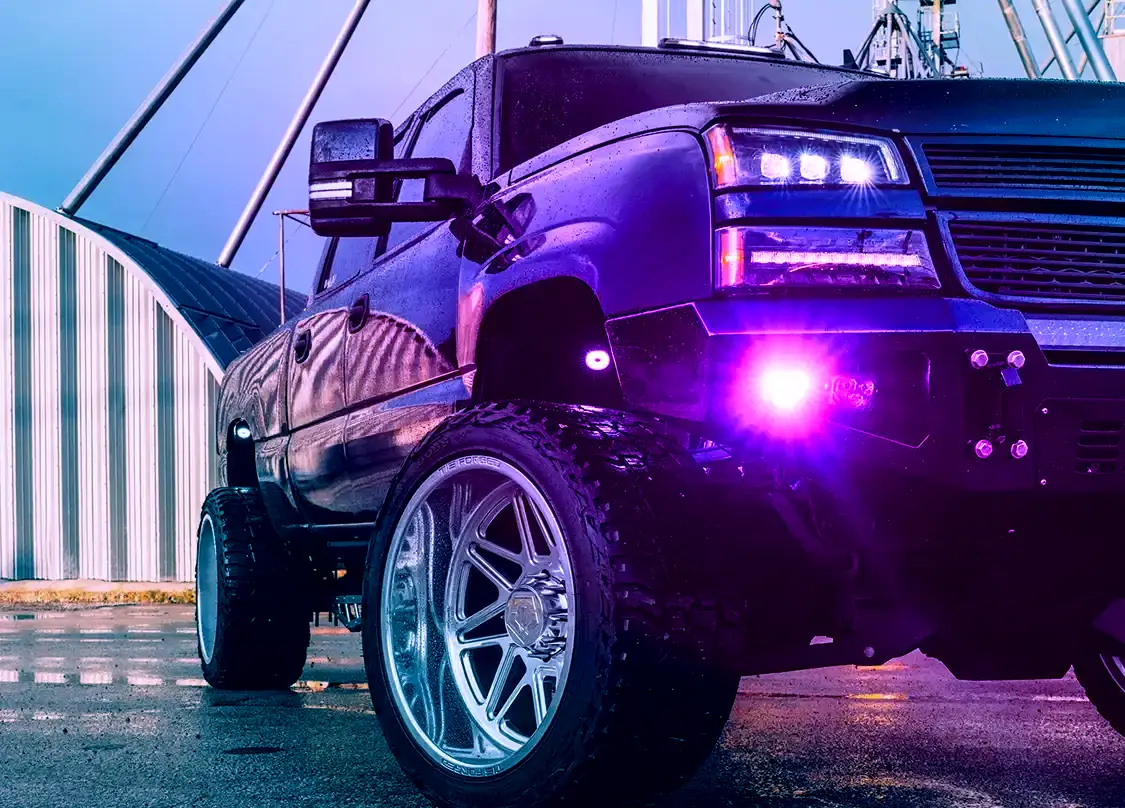
Plenty of builds reach a point where they look completely finished — the stance is dialed, the paint is flawless, and every detail has been thought through. Getting it on a trailer and to a show is the easy part. Driving it home on public roads is where gaps in the build start to surface, and where the consequences of those gaps go beyond a failed inspection sticker.
Builders put serious time into aesthetics and performance, and street compliance tends to get deprioritized along the way. It’s not always intentional, and lighting, mirrors, and exhaust routing don’t generate the same excitement as suspension or bodywork. Here’s where builds most frequently fall short of street-legal spec.
Aftermarket headlight setups can look far better than stock and still fail to meet federal motor vehicle safety standards. Projector retrofits with improperly aligned optics, LED conversions without the correct beam cutoff, and tinted or blacked-out covers that reduce output below minimum thresholds are all common on builds that see regular road use.
On the road at night, a non-compliant headlight setup reduces how far ahead you can see and how visible you are to oncoming traffic, and it creates liability exposure if reduced visibility contributes to a collision.
Most states require at minimum one driver-side exterior mirror and either a functioning interior rearview mirror or a passenger-side exterior mirror. Fender-mounted customs, relocated mirrors, and camera-based systems may or may not satisfy those requirements depending on the state where the vehicle is registered.
Builders pull mirrors off during body modifications and don’t always replace them with compliant alternatives. A vehicle driven in that condition is technically unregisterable for road use in most states, and if it’s involved in an accident, the missing or non-compliant mirror becomes part of the accident reconstruction conversation.
An aggressive fitment that photographs well can create handling problems under driving conditions. Stretched tires run at pressures too low for their load rating, extreme negative camber that reduces the contact patch on a straight road, and tires extending beyond the fender line are all setups that perform differently at 70 mph than they do rolling through a show field.
Tires have speed ratings and load ratings for a reason. A tire specced to fit a wide wheel on a static display hasn’t been validated for highway heat cycling, and a blowout at speed in that condition is not a recoverable situation.
Properly rated spacers from a reputable manufacturer, installed with the correct hardware and torqued to spec, are generally not a problem. Cheap spacers with inadequate studs, or spacers that push the hub offset further than the wheel bearing was designed to handle, create mechanical stress that accumulates over miles, and failure doesn’t announce itself in advance.
Side exits, dumps, and open cutouts are popular on trucks and performance builds, and they’re fine on a dedicated show vehicle. On anything with an enclosed cab driven regularly, exhaust placement relative to cab openings and door seals needs to be evaluated carefully.
Carbon monoxide intrusion is the risk. An exhaust exit positioned too close to a cab opening, combined with a door seal that’s been compromised or a firewall that’s been modified, can pull exhaust gases into the passenger compartment at highway speeds. Carbon monoxide is odorless, and the symptoms (fatigue, disorientation, impaired judgment) don’t always register as a problem until they’re severe.
Beyond cab intrusion, exhaust routing needs to account for:
Brake systems get compromised during builds more than almost any other system. A vehicle that’s been lifted, lowered, widened, or converted from drum to disc will have brake lines, proportioning valve settings, and pedal geometry that were designed for a different configuration than what’s currently under it.
Specific areas that need attention after a significant suspension or brake modification:
Brake fade at highway speeds and pulling under braking are symptoms a show car may never surface, but a street car driven in traffic will eventually encounter.
Suspension modifications change steering geometry, and the effects aren’t always apparent at low speeds. A truck lifted without correcting front CV angles, or a car slammed to the point where control arms run at extreme angles, can feel manageable on a smooth surface and unpredictable on public roads.
Bump steer happens when tie rod geometry doesn’t match the arc of the control arms through suspension travel, producing a pull or wander in the steering as the suspension cycles over bumps. It’s a known consequence of suspension lifts and drops that don’t include tie rod correction. On a highway, or during a hard lane change to avoid something in the road, that pull can take the vehicle out of the driver’s control before there’s any time to react.
A build optimized for dry, warm-weather shows can be poorly prepared for rain or cold, and this catches you off guard, especially when the vehicle performs fine all summer.
Specific gaps to check:
A modified vehicle that’s been in a collision gets examined differently than a stock one. Insurance adjusters and opposing car accident lawyers will look at whether the modifications contributed to the accident or the severity of injuries. Non-compliant lighting, out-of-spec tires, or compromised brakes can all be used to argue that the driver shares responsibility for what happened.
Show results are one measure of a finished build. A vehicle that performs safely and legally on public roads is another, and the two don’t automatically come together. Going back through lighting, mirrors, tires, exhaust, brakes, and steering with the same attention given to the aesthetics is what separates a build that’s ready for both from one that passes in a parking lot, but fails at 55 mph.

News
A car isn’t just metal, glass, and gears. It’s memories, movement, and money. But when the engine coughs or the brakes screech, those dreams begin… Continue reading
Motortopia Staff . July 17, 2025

News
Car tracking without the owner’s knowledge is technically possible using various modern technologies. The following paragraphs explain how it is done, the legal risks, and… Continue reading
Motortopia Staff . September 29, 2025

News
Photo source: Unsplash Driving is a key part of life in Dubai, and window tinting is a large part of individuals’ experience on the road.… Continue reading
Motortopia Staff . June 23, 2025
News
Print-through (telegraphing) happens when your adhesive sinks, shrinks, or exotherms hard enough that the show surface reflects what’s going on underneath. If you’re bonding carbon… Continue reading
Motortopia Staff . September 30, 2025

News
Miami doesn’t just move — it shimmers. From the palm-lined boulevards of Coral Gables to the neon pulse of South Beach, this city runs on… Continue reading
Motortopia Staff . November 24, 2025

News
Electric bikes have greatly facilitated daily travel, making it easier and more cost-effective. However, similar to any other vehicle, they require proper care. The battery,… Continue reading
Motortopia Staff . December 03, 2025



Goodguys 25th Meguiar's Del Mar Nationals Presented By FiTech Fuel Injection
Del Mar Fairgrounds 2260 Jimmy Durante Blvd., Del Mar, CA 92014
Goodguys 11th Griot's Garage North Carolina Nationals Presented By Grundy Insurance
North Carolina State Fairgrounds 4285 Trinity Rd, Raleigh, NC 27607
Classic burgers 6th annual classic car show fundraiser
6525 Inyokern rd Inyokern, ca 93527
Classic Burgers 6th Annual Car Show Fundraiser
Inyokern, CA
Whatcom County Cruisers
Whatcom County Cruisers Summer Car Show Series (Spring Car Show) Les Schwab Tires. 1731 LaBounty Dr. Ferndale WA 98248 (first event)


 Please wait...
Share Link