








 Motortopia Staff
.
March 10, 2026
.
Press Release
Motortopia Staff
.
March 10, 2026
.
Press Release
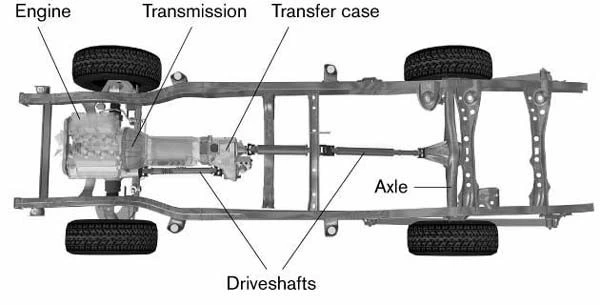
In a traditional combustion-powered 4×4, the engine sends power through a transmission and into the transfer case. The transfer case splits torque between the front and rear axles, enabling four-wheel drive. Mechanically, it is a strong and proven system.
At Fuel2Electric, we typically recommend four main EV conversion setups for 4×4 platforms, each with its own balance of authenticity, performance, weight, and maintenance.
We’ve divided this list into two categories: the five best drop-in kits and the five best custom kits available in 2026.
In this configuration, the electric motor replaces the engine but remains connected to the original gearbox and transfer case. Power flows through the drivetrain just as it did before.
The benefit here is continuity. The vehicle keeps its original architecture, including selectable high and low range. For heritage builds or owners who want to preserve the driving feel of their classic 4×4, this approach makes sense. It also reduces engineering uncertainty because axle ratios, driveshaft geometry, and mounting points stay unchanged.
However, keeping the full drivetrain means keeping weight and mechanical complexity. The transmission and transfer case add rotating mass and friction losses. They also require ongoing maintenance, including gear oil changes, seal replacements, and bearing replacements. In an electric conversion, where simplicity is one of the biggest advantages, this setup can feel heavier than necessary. Still, for serious off-road applications that rely on mechanical low range, it remains a strong option.
In this Motor Direct-to-Transfer Case configuration, the traditional transmission is eliminated.
This is one of the most popular solutions for 4×4 EV conversions. It reduces weight and mechanical losses while preserving low-range capability. Because electric motors produce strong torque across a broad RPM range, multiple forward gears are usually unnecessary. The result is a simpler, lighter drivetrain that still delivers authentic off-road performance.
You still retain the transfer case’s maintenance requirements, but overall complexity is reduced. For many builds, this configuration strikes an excellent balance between modern electric performance and traditional 4×4 capability.
The third setup takes simplification even further. In this configuration, a longitudinal electric motor is mounted centrally between the two axles, with each output stub connected directly to the front and rear differentials. Both the transmission and the traditional transfer case are eliminated.
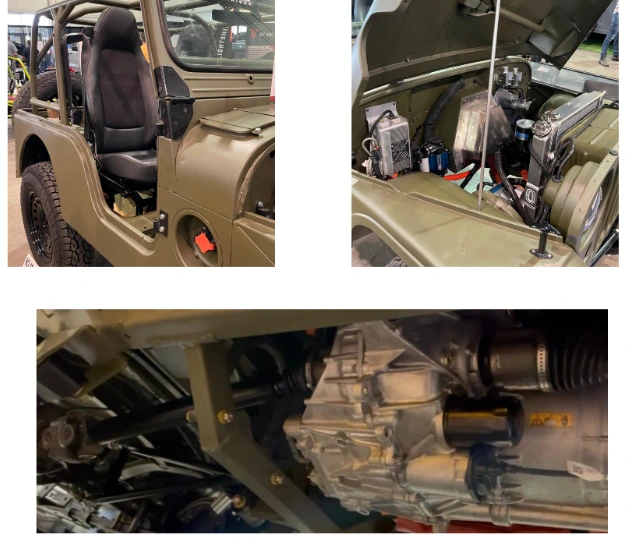
The main advantage of this approach is weight reduction and system integration. By designing a purpose-built electric drivetrain, you remove legacy components originally engineered for combustion engines. The result is a lighter, more efficient, and better-packaged system, with fewer gear meshes and fewer service points.
To make this work properly, the internal motor reduction ratio must be modified to match the vehicle’s original axle gearing and desired performance. This configuration delivers a cleaner, more modern drivetrain with lower long-term maintenance requirements.
The fourth setup is the most advanced: Dual Motor, one driving the front axle and one driving the rear, with no transfer case or front and rear diffs at all. In this layout, there is no mechanical link between axles. Torque distribution is handled electronically by motor controllers.
The benefits of this approach are significant. You eliminate the transfer case, central driveshaft, and related mechanical components. That means less weight, fewer moving parts, and lower maintenance. You also gain real-time electronic control of torque distribution. The system can send more power to the axle with traction instantly, improving stability and off-road capability.
This setup is mechanically simpler but electronically more sophisticated. For modernized 4×4 builds focused on efficiency, reliability, and cutting-edge capability, dual motor systems are often the most forward-looking solution.
Four Options, Your Choice
Across all four setups, the core benefit of EV conversion remains the same. Electric motors provide smooth, silent operation, instant torque delivery, and dramatically reduced maintenance compared to combustion engines.
The choice between maintaining the existing drivetrain and simplifying it comes down to priorities. Keeping original components can preserve character and off-road tradition, but it adds weight and ongoing mechanical service. Reducing or eliminating legacy parts lowers maintenance and often improves efficiency, but requires thoughtful engineering.
At Fuel2Electric, every project starts with one question: What is the mission of the vehicle? Once that is clear, the right drivetrain architecture follows.
Press Release
The XDP Billet Tow & Race Series Flex Plate is an essential upgrade for any modified diesel truck. If your truck is used for racing,… Continue reading
Motortopia Staff . September 09, 2024

Press Release
7.3L Billet Dipstick Adapter Assembly One of the most common oil leaks on the 7.3L Powerstroke comes from the OE dipstick assembly. Fix that oil… Continue reading
Motortopia Staff . January 02, 2025

Press Release
Classic Looks, Modern Tech: Custom Autosound USA-630 Stereo Bring modern performance to your classic ride with the USA-630 from Custom Autosound. Designed to fit your… Continue reading
Motortopia Staff . April 08, 2025
Press Release
Hard shell roof top tent Our hard shell roof top tent design focuses on functionality and simplicity at its core. The tent features an innovating… Continue reading
Motortopia Staff . July 29, 2024

Press Release
Bodyguard Bumpers (Paris, Texas) offers a premium lineup of heavy-duty replacement bumpers and metal armor which are 100% designed and manufactured in the USA. All… Continue reading
Motortopia Staff . May 20, 2025

Press Release
CPP introduces its newest addition to the Corvette style spindle product line. Our Corvette Style wheel brake kits utilize a Corvette style hub assembly and… Continue reading
Motortopia Staff . February 05, 2025


NTEA Work Truck Week
Indianapolis, IN
C10’s in the Swamp
Florida classic park, Brooksville FL
Goodguys 16th FiTech Fuel Injection Spring Nationals
WestWorld of Scottsdale 16601 North Pima Road, Scottsdale, AZ 85260
Terminal Takeover 2026
21 airport rd Ext, Greenville, SC
Altered Metal 2026
Rayne, LA


 Please wait...
Share Link