










 Tony Thacker
.
September 08, 2026
.
Chevrolet
Tony Thacker
.
September 08, 2026
.
Chevrolet
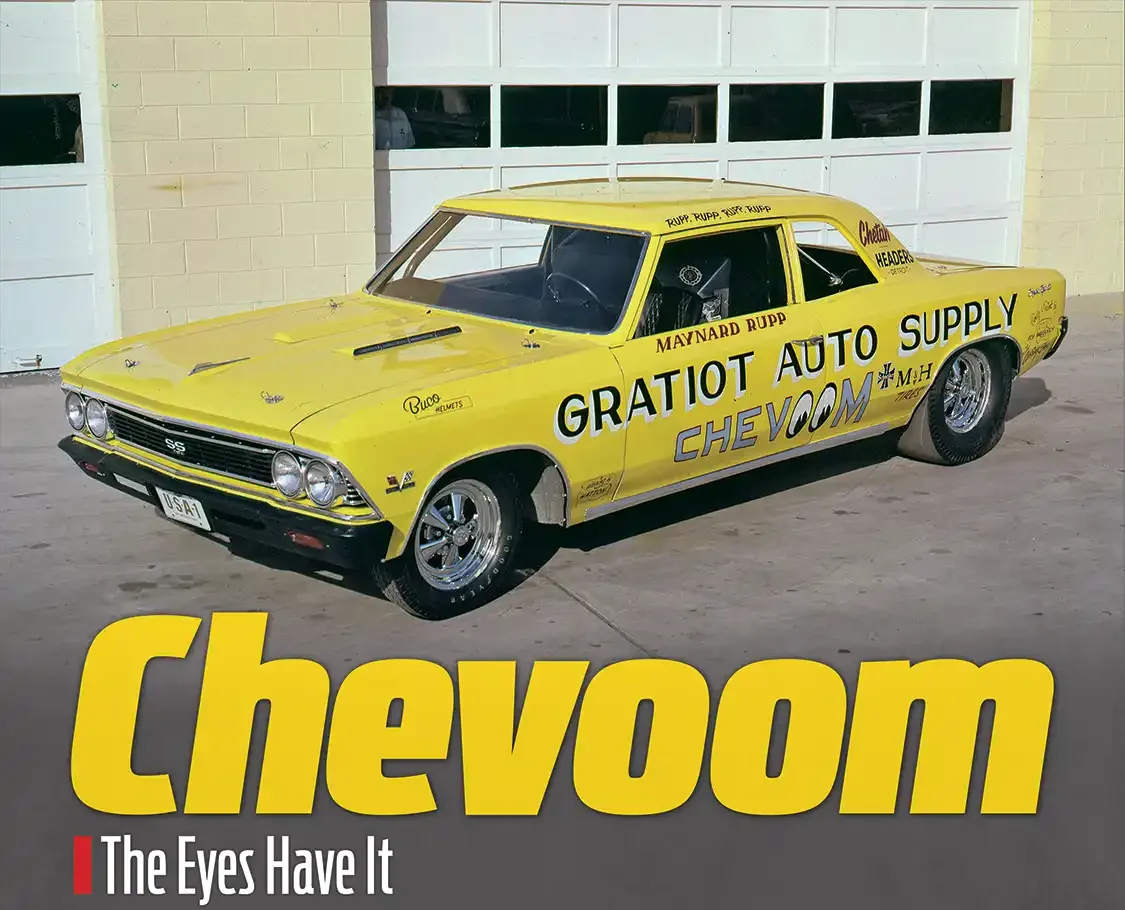
Since 1965, when I bought my first hot rod T-shirt, a Mooneyes garment, I’ve been attracted to those moon eyes. I only met Dean Moon once, but there’s something that draws me to his iconic logo, apparently one of the most recognized in the world.
I was recently in the Orange County, California, shop of my friend Bob Marianich, and hanging on the wall was a big photograph of Chevoom. I asked, “How come you have this on the wall?”
“I worked on it back in Detroit.” He replied. “There’s my name on the rear quarter.” Right behind the rear wheel appeared “Paint and Body by Bob Marianich The Carriage Shop.” Intrigued by anything associated with Moon, I enquired about the story of the car.
In the formative years of Funny Cars, before today’s cookie-cutter formula, there existed what was called “experimentation.” It was what made drag racing so fascinating. Evolving from the Factory “eXperimental” class, the first were the ’64 Dodge Chargers built by Dragmaster. They were quickly followed by Jack Chrisman’s blown 427 SOHC Comet with the wheels pushed forward. It looked funny and the name stuck. Then, in January 1966, “Dyno” Don Nicholson unveiled the first tube-frame Funny. He was not alone.
Watching these developments was Detroit Top Fuel racer Maynard Rupp. In 1965, the team of brothers, Ron and Gene Logghe (Logghe Bros. Chassis); Roy Steffey with Maynard Rupp driving The Prussian AA/FD won two of the four NHRA national events: the Spring Nationals and the World Finals, clinching the T/F World Championship.
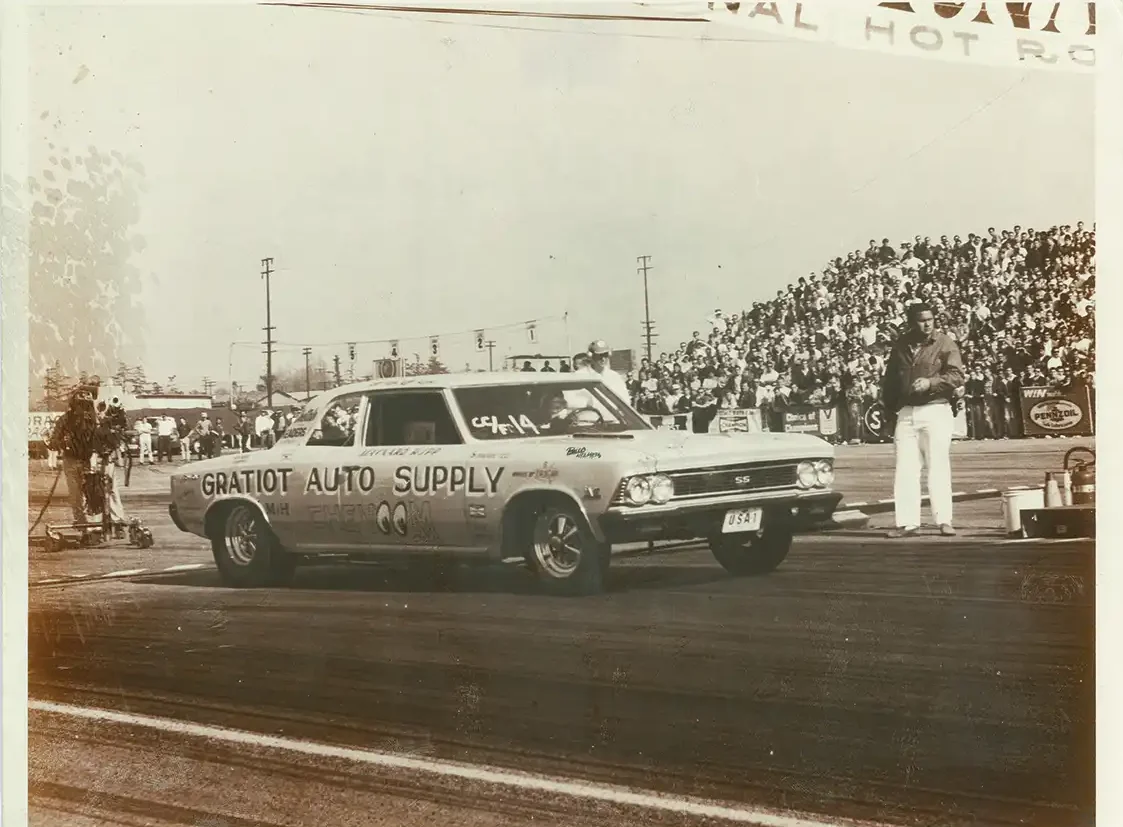
The Prussian was displayed at the 1966 Autorama at Detroit’s Cobo Hall. Alongside the Prussian, so named because of Steffey and Rupp’s German heritage, was a new car, Chevoom, that Rupp had begun developing the previous year. Being rear-engined (technically mid-engined), Chevoom was a beautiful car that won that year’s prestigious Ridler Award. Following the Autorama, the car was shipped to California for the NHRA Winternationals (Feb. 21-23) when Dean Moon photographed it. It also graced the cover of the May 1966 issue of Drag Strip magazine.
Chevoom’s powertrain layout was unusual because the Chrysler Hemi was mounted mid-ships over the driver’s right shoulder where the backseat would normally be.
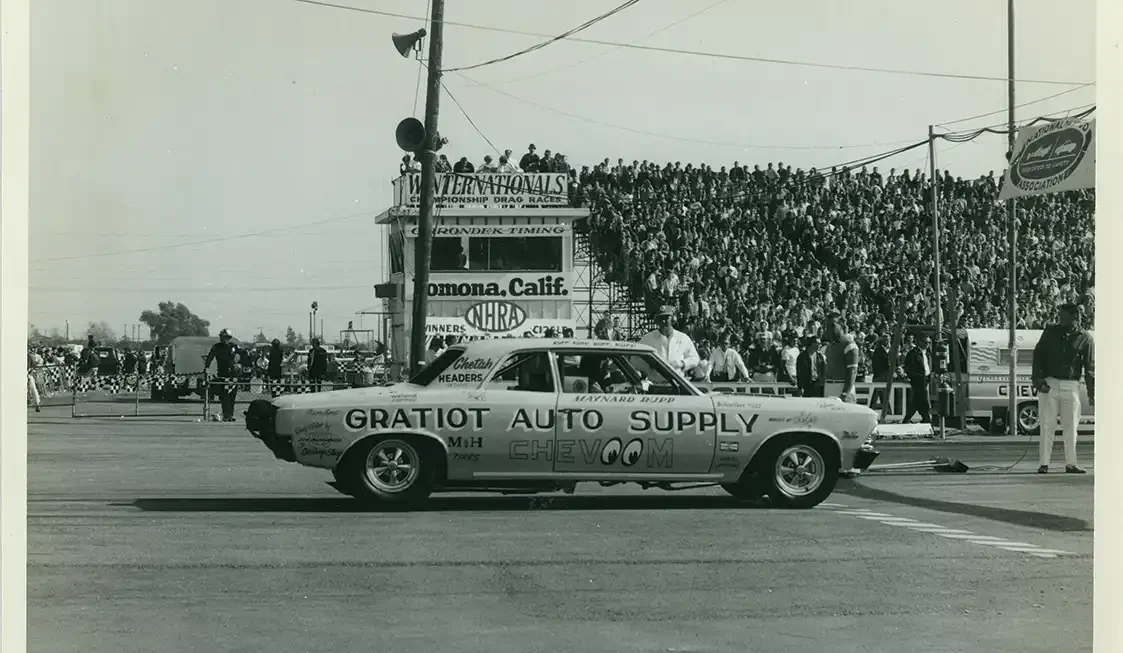
The body for the car was created by Bob and Nancy Mangold at B&N Fiberglass, Dayton, Ohio. According to Rupp, he borrowed the front fenders, doors, trunk lid, bumpers and a hood from a local Chevy dealer, but Bob Mangold noted the actual Chevelle two- door hardtop body came from the local GM factory and B&N splashed it all. A unique feature was its opening doors, hood and deck lid. Even the head, tail and interior lights worked in the early version. Later action shots show the headlights removed. Bob Mangold is still in business making fiberglass Corvette bodies at Backtothefutureproductsllc.com in Oak Harbor, Washington.
From Ohio, the body went to Detroit, where Rupp built the frame in a muffler shop belonging to Gratiot Auto Supply (GAS). Located on Gratiot Avenue, Detroit, not far from the famed Woodward Avenue, GAS was owned by Angelo “Junior” Giampetroni and Bill Toia and was one of the oldest and biggest speed shops in the country.
According to Bob Marianich, the body mounted on the frame then came to his shop near Gratiot. There, Marianich hung the doors, hood and deck lid, making them all operational (the hood and deck lid were held on with pins). He also fabricated the aluminum bulkhead, engine cover, wheel tubs and instrument panel, saying, “I remember there was the usual rush to get it done and painted Moon yellow for Cobo Hall. After me it went to the striper, Paul Hatton, for lettering. Paul was well known around Detroit. He did all the lettering and striping.” He was also known for hand-striping 50 Rambler Scramblers a day at the Hurst plant in Kenosha, Wisconsin. Marianich went on to a career in advanced design and helped establish Toyota’s West Coast design studio, Calty.
For power, Rupp chose a GMC blown 1956 354-ci Hemi with Enderle injection coupled to an Art Carr Torqueflite transmission and a Dodge rearend. The ribbed three-hole injector faced the rear rather than the front of the car.
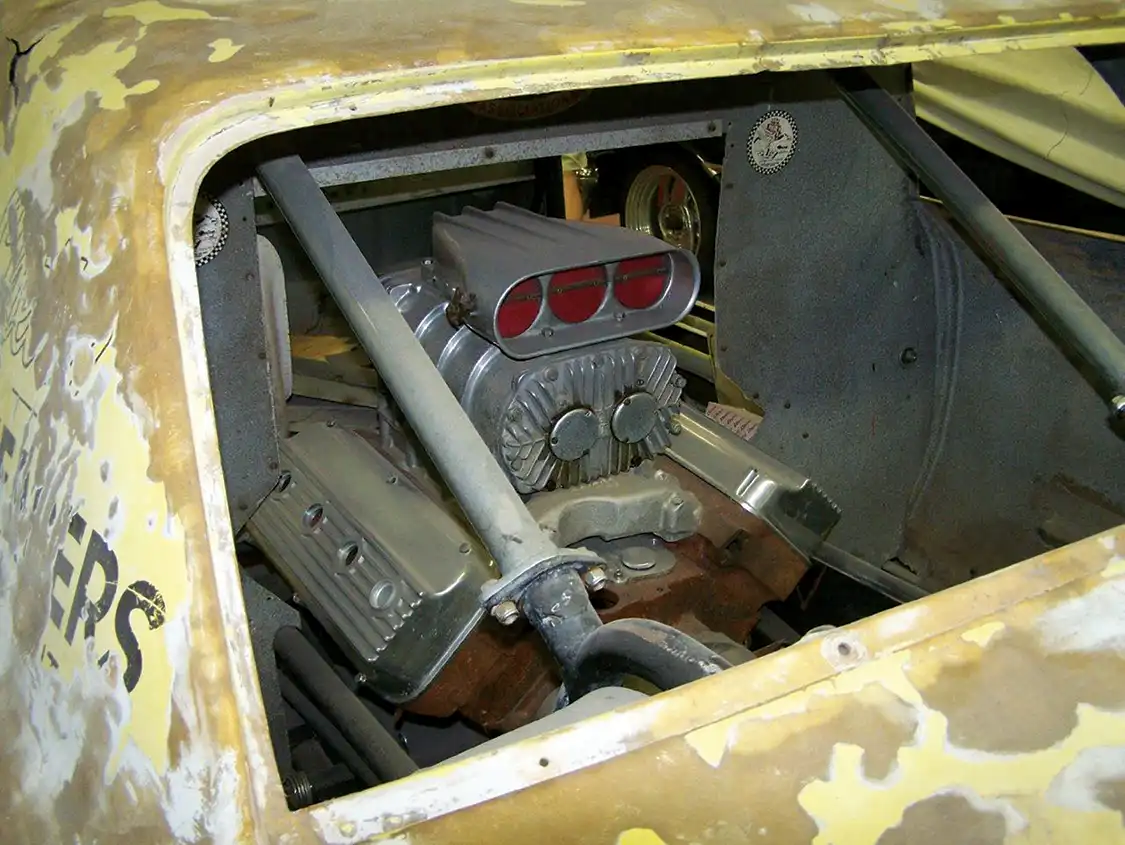
Chevoom’s powertrain layout was unusual because the Chrysler Hemi was mounted mid-ships over the driver’s right shoulder where the backseat would normally be. Rupp laid out the parallel tube frame and roll cage using round 4130 chrome-moly tubing, however, the pivoting engine cradle was made out of rectangular tubing suspended in the rear with coil-over shocks. Unlike the other back-motored Funny Cars, Rupp sat not in the middle of the car, but in the normal driving position.
The chrome front end was uncomplicated with a straight tube axle fitted with radius rods and suspended by a transverse leaf spring and tube shocks; there were no front brakes. If one considers the timing of this build, hot on the heels of Dyno Don, it’s obvious that Rupp was on top of the technology of the times with a mid-engined tube frame lift-off-body Funny Car.
For power, Rupp chose a GMC blown 1956 354-ci Hemi with Enderle injection coupled to an Art Carr Torqueflite transmission and a Dodge rearend. The ribbed three-hole injector faced the rear rather than the front of the car. The engine was fitted with a Schneider cam, finned M/T valve covers and Chetah headers. Many of the parts were supplied by Gratiot or Mooneyes as part of their sponsorships.
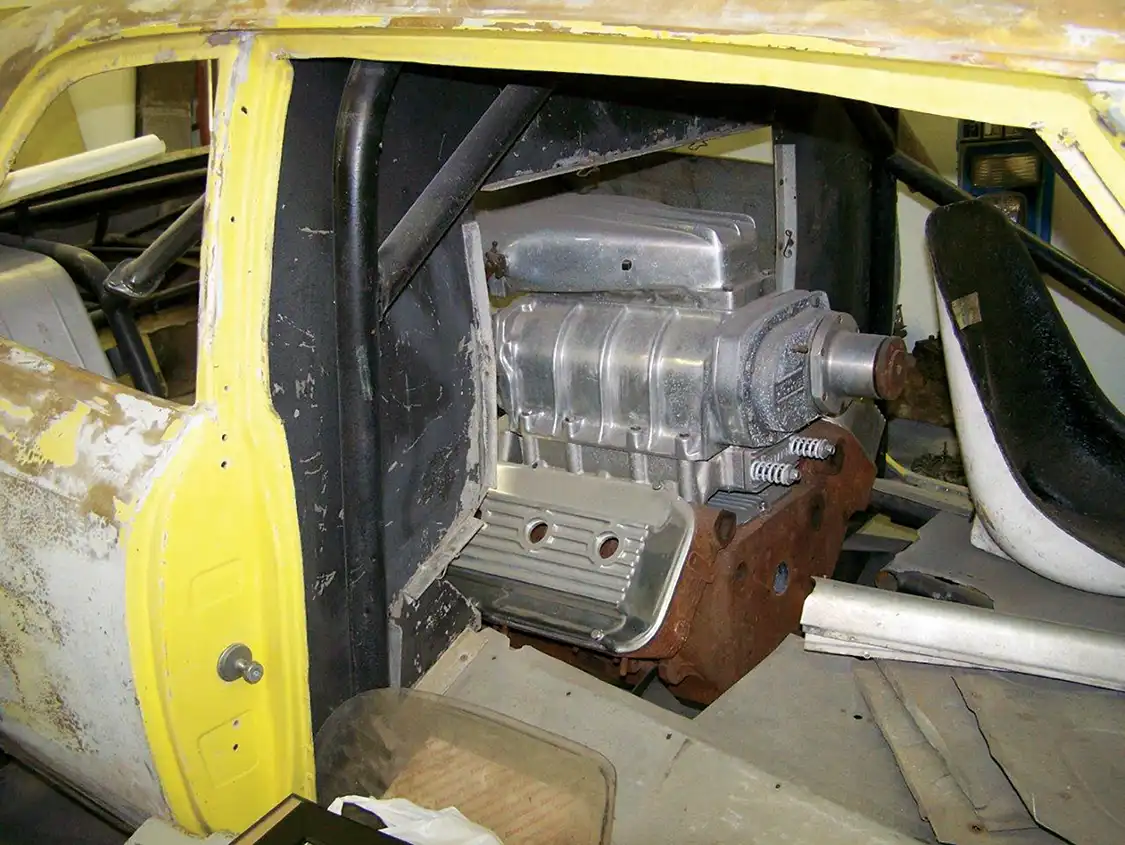
To accommodate the powertrain setup, the rear Cragars shod with M&H slicks were pushed back almost to the corners; there was barely enough room for Bob Marianich’s name. That was the opposite of most altered-wheelbase Funny Cars, which featured the rear wheels pushed forward for weight transfer. Note that there are several shots of the car with unpolished magnesium Halibrand wheels including spindle-mount fronts.
Unfortunately, despite all of the ingenious engineering, Chevoom did not perform as well as Rupp had hoped. Indeed, the early back-motored Funny Cars fared poorly: Doug Thorley’s Javelin flipped at Irwindale and Tom McEwen flew his Hemi ’Cuda on a test run at Lions. Jim Dunn and Joe Reath did have limited success. The duo, with Dunn driving their rear-engine ‘Cuda, won the 1972 NHRA Supernationals. For all his efforts, Rupp ran a best of 8.635 seconds at 166 mph, which was equal to his contemporaries. As part of the show, Rupp also had a very cool Ford C series cab-over in matching yellow paint that predated other, similar drag car haulers.
As part of the show, Rupp also had a very cool Ford C series cab-over in matching yellow paint that predated other similar drag car haulers.
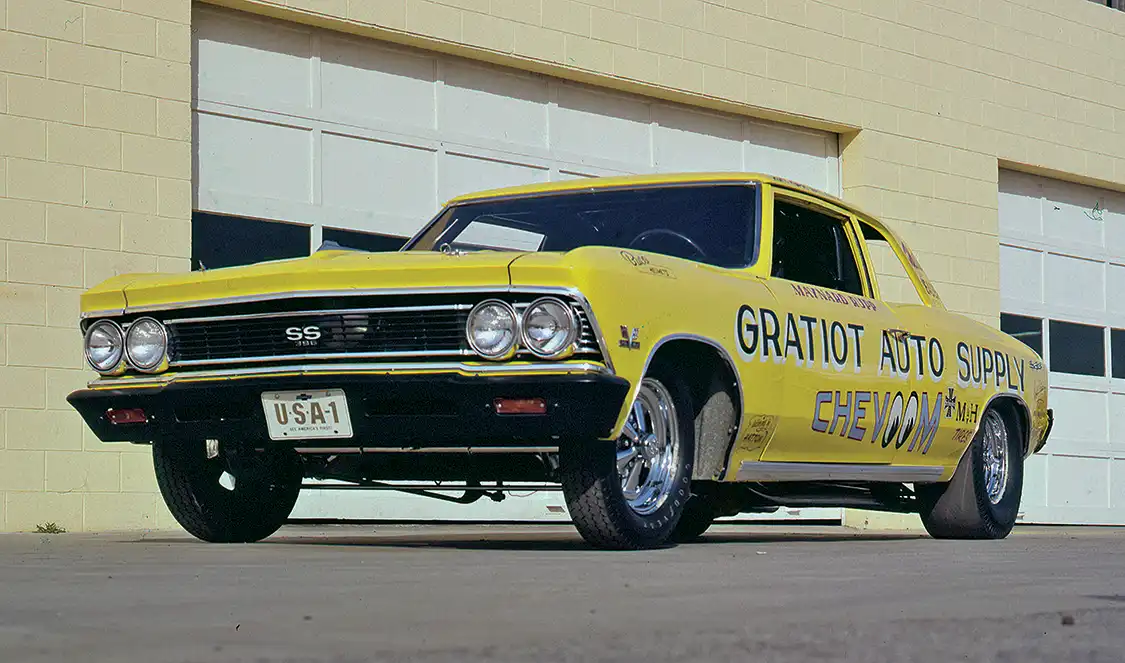
Alas, Chevoom’s performance was soon eclipsed by its competitors. Besides, the car was rather squirrely at the top end. Consequently, at the end of the 1966 season, Rupp sold the car to a guy near Sandusky, Ohio, where it sat outside a barn with a blown motor until the early- ’80s when Ken Bigham of Gettysburg, Pennsylvania, purchased it. Ken has owned the car ever since. However, it was advertised for sale in the March 22, 1968 issue of National Dragster with Sandra Haney as the contact.
Fast forward 30 years to 2006 and the Holley Hot Rod Reunion in Bowling Green, Kentucky. There, looking a little sad, was Chevoom, seemingly being readied for paint. You could just make out “Gratiot Auto Supply” and the “voom” of “Chevoom.” The price tag then was apparently $20k. Not bad for a survivor.
Rupp went on to campaign another Funny Car with Steffey. Sponsored by STP, the SOHC-powered Cougar Country Mercury Cougar had the best and lightest parts available, and yet, the duo did not fare well. At the end of the 1967 season, they hung it up and pursued different careers: Rupp as a corporate pilot. As of this writing, Chevoom still sits in Ken Bigham’s garage.
Buyer’s Guides
Classic Lookin’ Meets New-School Bookin’ The love for speed is nothing new, whether it be by foot, chariot or combustion engine. We might be biased,… Continue reading
Mike Self . February 12, 2026
All Feature Vehicles
A Loving Tribute I’ve often made the joke that stepladders are like real ladders, they just love you half as much. Stepfathers are in fact… Continue reading
PHIL GORDAN . December 13, 2023
Feature Stories
This 2001 Isuzu Vehicross is one couple’s do-anything rig. More than 20 years of off-road wheeling around the Pacific Northwest has brought James and Molly… Continue reading
Anya Murphy . September 26, 2023
Feature Stories
AS SEEN IN OUR TREAD MARCH/APRIL 2026 ISSUE – Buy Now! The Story of an Untold Legend This isn’t just any story, and this isn’t… Continue reading
Chad Dougla S . June 22, 2026
C10 Builders Guide
A Second Chance Yields a Major Payoff COMING UP WITH TITLES FOR FEATURES CAN BE DAUNTING. Sometimes we luck out and the owner already has… Continue reading
Mike Self . January 05, 2026
Events
Hey, gearheads, I’m Chris Hamilton, editor-in-chief over at Motortopia. It’s Monday, November 3, 2025, and we’re already deep in the chaos that is SEMA setup… Continue reading
Chris Hamilton . November 03, 2025


Goodguys 28th Griot’s Garage Colorado Nationals
The Ranch Events Complex 5280 Arena Circle, Loveland, CO 80538
Florence Fall Classic
Florence Fall Classic Car Show Old Town Florence Oregon
Elks Auto Show
Elks Auto Show 1140 Umpqua College Rd. Winchester OR. 97470
42nd Oregon High Desert Swap Meet, Car Show And Antiques
Deschutes County Fairgrounds 3800 Airport Way, Redmond, Oregon 97756
International Drive Your Studebaker Day
89 Center Rd., Petaluma, CA
We use cookies to enhance your browsing experience, serve personalized ads or content, and analyze our traffic. By clicking "Accept All", you consent to our use of cookies. Visit our Cookie Policy for more info.


 Please wait...
Share Link