








 Motortopia Staff
.
February 02, 2026
.
Press Release
Motortopia Staff
.
February 02, 2026
.
Press Release
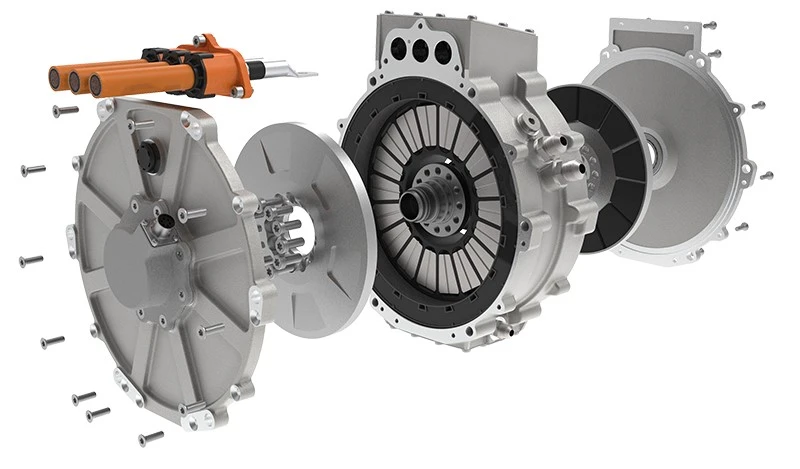
Electric motors sit at the very heart of every EV conversion. They are where electrical energy finally becomes motion, torque, and driving feel. While motors are often described as AC or DC, the more meaningful distinction — especially when thinking about performance, packaging, and future potential — lies in how magnetic flux is arranged inside the machine. From that perspective, electric motors fall into two main families: radial flux motors, which power almost every EV on the road today, and axial flux motors, which are opening exciting new possibilities for the next generation of electric mobility.
Radial Flux Motors: The Rock-Solid Backbone of EV Conversions
Radial flux motors are the quiet workhorses of electrification. In these machines, magnetic flux flows perpendicular to the axis of rotation, crossing the air gap radially between a cylindrical rotor and stator. This geometry has been refined for decades, resulting in motors that are reliable, predictable, and exceptionally well understood.
For EV conversions, this matters enormously. Radial flux motors integrate naturally with reduction gearboxes, tolerate high rotational speeds, and are easier to cool under sustained load. Their mechanical stiffness and thermal behavior make them forgiving in real-world driving, whether in a daily driver, a classic car conversion, or a light commercial vehicle.
It’s no coincidence that roughly 99% of electric motor applications today, including almost all production EVs, rely on radial flux designs. They are efficient, scalable, and backed by a mature global supply chain — all qualities that align perfectly with dependable, road-ready EV conversions.
One common source of confusion is the idea that radial or axial flux motors are somehow tied to AC or DC operation. In reality, flux orientation describes the physical layout of the motor, not how it is powered. Modern EV motors are almost always driven by three-phase AC generated by an inverter, even though the battery supplies DC power.
Most EV traction motors today are radial-flux permanent-magnet synchronous machines or induction motors. The electrical behavior and the magnetic geometry are separate design choices, and understanding that distinction helps make sense of why certain motor technologies dominate production vehicles while others remain more specialized.
Axial flux motors take a very different approach. In these machines, magnetic flux flows parallel to the axis of rotation. The result is a flat, disk-shaped motor, often described as a pancake design, with stators and rotors arranged face-to-face rather than concentrically.
What’s fascinating is that axial flux motors are not a new idea at all. The first electric generator built by Michael Faraday was an axial flux machine. What’s changed is our ability to manufacture them precisely, cool them effectively, and control them intelligently using modern power electronics.
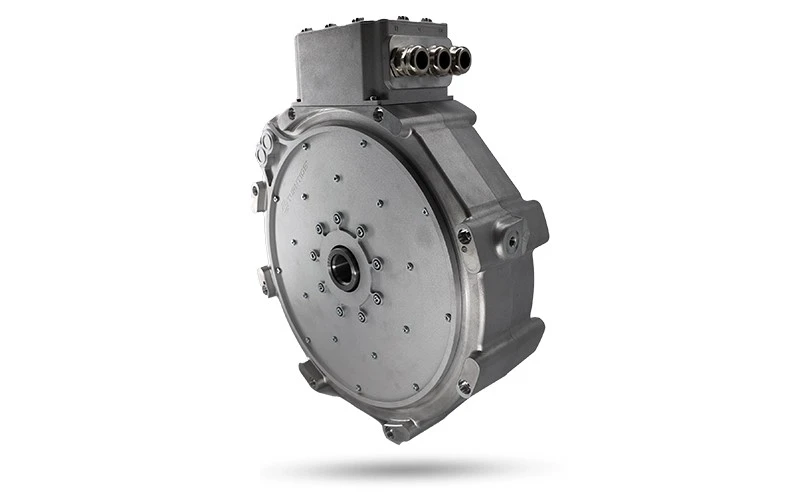
Several companies are shaping this evolution in distinct ways. YASA has set the benchmark for axial flux motors in automotive and aerospace applications, proving that the technology can meet demanding real-world requirements. Turntide Technologies is advancing axial flux motors with a strong focus on efficiency and intelligent control, targeting applications where energy optimization is critical.
Meanwhile, so-called donut motors explore creative geometries and packaging strategies, sometimes enabling direct-drive or near-hub configurations. Many of these designs remain radial flux at their core, but they reflect the same push toward compactness, simplicity, and higher torque density — qualities that resonate strongly in the EV conversion world.
For today’s EV conversions, radial flux motors remain the most practical and proven solution. They are robust, adaptable, and well supported by existing components and expertise. At the same time, axial flux motors represent an exciting glimpse into what’s coming next, especially for performance builds, weight-sensitive platforms, and innovative layouts.
The fundamentals are strong, the technology is advancing fast, and the gap between cutting-edge motor design and real-world EV conversions is steadily closing.
Whether it’s refining proven radial flux systems or preparing for the next wave of axial flux innovation, the future of electric conversion has never looked more promising.

Press Release
The RIGID SR-L Series Spreader light provides an easy way to add convenient area lighting and style toany vehicle. This spreader provides a broad 120… Continue reading
Rhea Sharma . July 10, 2023

Press Release
The engineering team at Art Morrison Enterprises (AME) is once again capturing the attention of the Corvette community with the launch of their revolutionary Bolt-On… Continue reading
Motortopia Staff . October 25, 2024
Press Release
QT1179 Economy Bearing Cup Remover Punch is specifically made for the Do-it Yourself mechanic that needs a good, functional, yet lower cost Bearing Cup Removal… Continue reading
Motortopia Staff . October 16, 2023

Press Release
Classic Looks, Modern Tech: Custom Autosound USA-630 Stereo Bring modern performance to your classic ride with the USA-630 from Custom Autosound. Designed to fit your… Continue reading
Motortopia Staff . April 08, 2025

Press Release
Corona, California – November 12, 2024 – TMI Products, the leader in custom automotive interiors, introduces a complete interior product line for the 1986-1987 Chevrolet… Continue reading
Motortopia Staff . November 12, 2024
Press Release
Flagstaff, AZ, April 9, 2025 – KC HiLiTES, the brand that’s been lighting the way for adventurers since 1970, is breaking new ground: Introducing KC… Continue reading
Motortopia Staff . April 18, 2025



Orange Beach Invasion 2026
The Wharf Orange Beach, Alabama
Southern Tradition Car/Truck Show 2026
Etowah River Park Canton, GA
Local Studebaker Drivers Club Chapter Private Tour Of John Muir House
John Muir House 4202 Alhambra Ave., Martinez, CA
Goodguys 42nd All American Get-Together
Alameda County Fairgrounds 4501 Pleasanton Avenue, Pleasanton, CA 94566
Goodguys 25th Meguiar's Del Mar Nationals Presented By FiTech Fuel Injection
Del Mar Fairgrounds 2260 Jimmy Durante Blvd., Del Mar, CA 92014




 Please wait...
Share Link