








 Motortopia Staff
.
March 20, 2026
.
Press Release
Motortopia Staff
.
March 20, 2026
.
Press Release
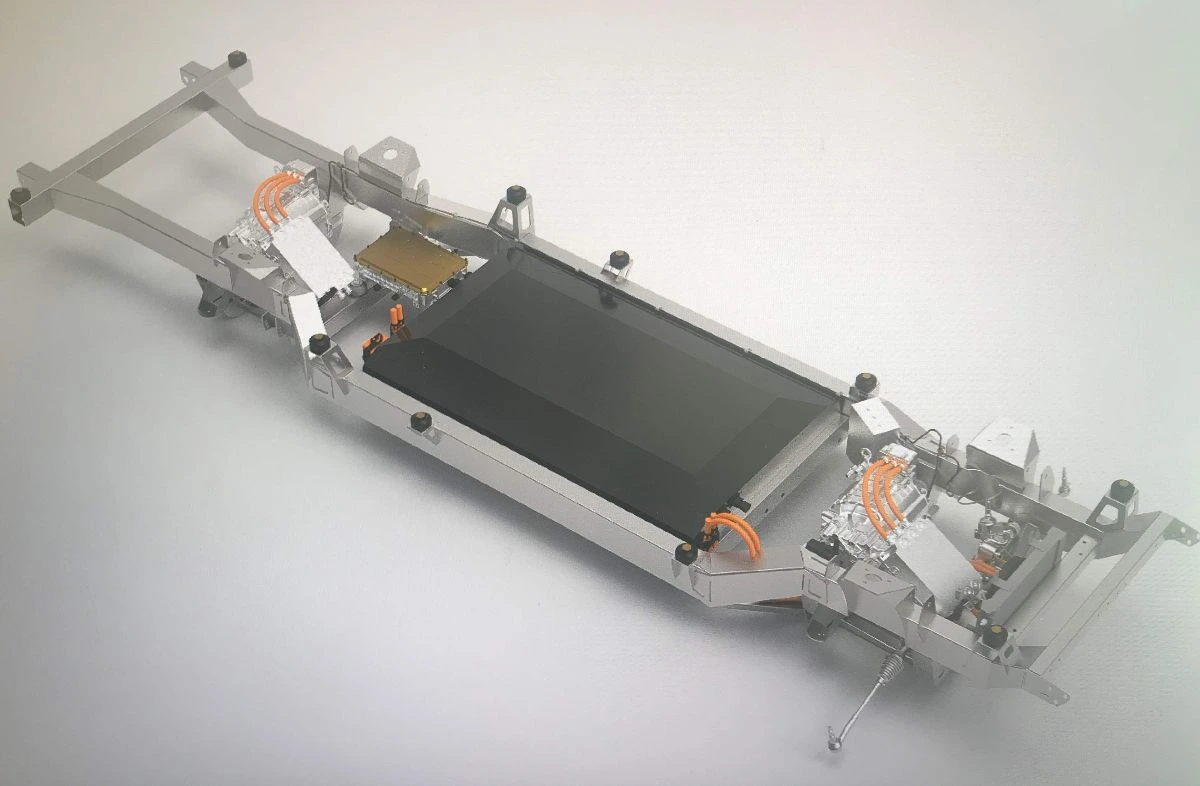
You know your classic deserves better than another carburetor rebuild, another oil change, another morning where it just doesn’t start. You’ve decided to go electric. Smart.
Now comes the part that separates the daydreamers from the builders:
Understanding what actually lives under the hood of an EV conversion and why every single piece matters.
This isn’t a glossary. This is your roadmap. Ten components, each one with a job to do, each one connected to the next. Get them right and you’ve got something extraordinary. Skip the homework and you’ll be chasing gremlins at 11pm with a multimeter and regret. Let’s make sure that doesn’t happen.
1. The Battery Pack | Your Fuel Tank, Reinvented
Everything starts here. The battery pack is where energy lives; stored as chemistry, ready to become motion the moment you ask for it. Capacity is measured in kilowatt-hours (kWh), and that number tells you how far you’ll go. Unlike a gas tank that gets lighter as you drive, the battery weighs the same full or empty. That weight is an engineering puzzle, and when you solve it with smart placement and the right BMS, your car handles better than it ever did with an engine up front. Continue reading.
2. The Battery Management System (BMS) | The One That Never Sleeps
The BMS watches every single cell, every second, and makes sure nothing wanders outside its happy zone: voltage, temperature, state of charge. It balances the cells during charging, so no single one runs ahead and gets cooked. It cuts power if temperatures climb too high. It estimates your remaining range in real time. Think of it as the crew chief of your entire powertrain. It doesn’t get tired, doesn’t take breaks, and will absolutely save your build if something starts going sideways. Continue reading.
3. The Motor Controller / Inverter | The Translator
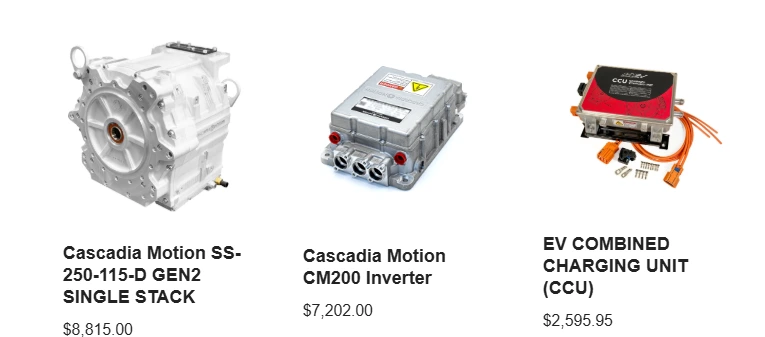
Your battery speaks DC. Your motor wants AC. The controller is the translator between them, and it does the job faster and more precisely than anything in the combustion world ever managed. Using pulse width modulation, it switches high-voltage transistors thousands of times per second to synthesize exactly the AC waveform the motor needs. More than that, it controls torque delivery in real time, smoothly, instantly, with a finesse that a throttle body and fuel injector can only dream about. It also handles regenerative braking, reversing the energy flow to push electricity back into the pack every time you lift off. One component doing the work of half a drivetrain. Continue reading.
4. The Electric Motor | Where Physics Gets Fun
Full torque from zero RPM. No warmup, no powerband to chase, no lag. The motor converts electrical energy into mechanical rotation through electromagnetic induction, and it does it with an efficiency that would make any combustion engineer quietly uncomfortable. There are four main types of AC motors used in EVs: Permanent Magnet Synchronous Motor, Electrically Excited Synchronous Motor, Switched Reluctance Motor and Induction Motor. Either way, the moment you press that accelerator and feel the instant pull, the debate is over. This is what driving was always supposed to feel like. Continue reading.
5. The On-Board Charger (OBC) | Your Connection To The Grid
The OBC is what lets you plug in at home, at a Level 2 station, or anywhere with an outlet and actually put energy back in the pack. It converts AC from the wall into the DC voltage your battery needs, following a CC/CV charging curve: constant current (CC) to fill the pack quickly, then constant voltage (CV) to top it off gently without stress. A bigger OBC means faster charging. A well-designed one means your pack ages gracefully. Slow charging (0.3C) overnight is a kindness your cells will repay with years of extra life. Continue reading.
6. The DC-DC Converter | The Unrewarded Hero
Nobody talks about the DC-DC converter at car shows. Nobody should; it’s not glamorous. But without it, nothing in your cabin works. Your lights, your horn, your dash, your wipers… All of it runs on 12V. The DC-DC converter takes the high voltage from your main pack and steps it down continuously, replacing the alternator that used to do that job. The difference is it does it better: no moving parts, no belt to snap, no charging curve tied to engine RPM. It just works, quietly, all the time. Size it to at least 120% of your calculated 12V load and you’ll never think about it again. Continue reading.

Press Release
Pro’s Pick offers a truck bed kit for 1973 to 1979 Ford Flareside trucks! You can expect the same quality and build process they have… Continue reading
Motortopia Staff . January 03, 2024

Press Release
The ZROADZ ARB® Compressor Mounting Bracket is specially designed to mount the ARB® High-Performance Twin On-Board Air Compressor (ARB® Part #: CKMTA12), ARB® Manifold Kit… Continue reading
Motortopia Staff . March 24, 2025

Press Release
QT1261 6-Pin Spindle Nut Wrench is specifically engineered to fit the 2-1/2″ thread x 12 Slot Factory Spindle Nut used on Dual Rear Wheel AAM… Continue reading
Motortopia Staff . October 17, 2023

Press Release
Kyle Chaney just rewrote the rulebook at King of the Hammers, proving that a Can-Am Maverick R on 37” Maxxis Roxxzillas isn’t just fast—it’s unstoppable.… Continue reading
Motortopia Staff . February 12, 2025

Press Release
Atlanta, GA – In 2024, Fox Factory Inc unveiled a super truck built on the Chevrolet Silverado 1500 4WD platform that was the result of… Continue reading
Motortopia Staff . April 14, 2025
C10 Builders Guide
FOR IMMEDIATE RELEASE Street Trucks Military Charity Build Sergeant Square Goes Live on Auction Tomorrow, July 4 Durham, North Carolina, July 3, 2024 – Street… Continue reading
Nicole Hamilton . July 03, 2024



Terminal Takeover 2026
21 airport rd Ext, Greenville, SC
Altered Metal 2026
Rayne, LA
Orange Beach Invasion 2026
The Wharf Orange Beach, Alabama
Southern Tradition Car/Truck Show 2026
Etowah River Park Canton, GA
Local Studebaker Drivers Club Chapter Private Tour Of John Muir House
John Muir House 4202 Alhambra Ave., Martinez, CA



 Please wait...
Share Link