










 Lisa Giosi
.
June 10, 2026
.
Drag Racer
Lisa Giosi
.
June 10, 2026
.
Drag Racer
Titanium, it’s on the periodic table, but it might surprise some people that it’s also being used in the top cars competing in the nation’s most popular racing series. As the fourth most abundant metal on earth, titanium has found a home in many different industries, including aerospace, medical and knife making. While some of these industries have been employing titanium for more than 70 years, the metal has been used in racing for nearly five decades now.
At the time it was being introduced into the racing community, titanium was used primarily in aerospace. With military grades and traceability options, in addition to titanium’s innate qualities of lightness and durability, it was seen as the metal one would use when building a plane, not a car. Yet, as engineers began to experiment with various materials to decrease the weight of their cars, they discovered that there were more options available than they had originally thought. “It’s interesting how titanium got its start in racing,” says James Hostetler, senior vice president at TMS Titanium. “For us, it all started when the racing community picked up titanium from aerospace surplus and found that although there is a significant cost to purchase and make parts, titanium has an increased lifecycle…It reduces assembly weights, which increases rpm and lowers resulting damage.”
For those who may not be as familiar with the metal as Hostetler is, titanium is a naturally occurring element, and as stated previously, the earth is generously stocked. Found in the sand on beaches primarily in Asia and Australia, the titanium particles are chemically reduced, melted, forged and rolled into what becomes the usable metal that is ultimately acquired by racing engineers. The overall manufacturing process is lengthy, taking at least six months, and in some cases a year, to complete. There has been an industry-wide misconception that all titanium is manufactured in Russia, when in fact it is also produced in the United States and Asia.
Lack of exploration wasn’t the only reason why titanium had little presence in the racing industry. Another reason was due to regulations sanctioning bodies imposed upon participating teams. “We first started using titanium parts on the race car to a sizable degree around 1984,” recalls John Medlen, world championship crew chief for John Force Racing. “Titanium started gaining popularity when the NHRA began placing minimum weight requirements on race cars, allowing us to experiment with different materials.”
Today, many racing series use titanium for driver and heat protection. Many series including TUDOR United SportsCar Championship (the 2014 merger of GRAND-AM Road Racing and the American Le Mans Series) have tight restrictions when it comes to using the material for parts, leading engineers to some of their most creative ideas when incorporating titanium into parts and engines.
While titanium has taken a bigger role in race cars, not everyone was onboard to work with the metal from the get-go. The long-standing myth that titanium is a difficult material to work with kept a lot of engineers reaching for more familiar materials, such as aluminum and steel. Though both metals have beneficial qualities, titanium can serve as a convenient one-stop-shop for all of the qualities an engineer is looking for when creating a part, such as strength, lightness and flexibility. Though these characteristics tend to be the most sought-after aspects, titanium’s use as a protectant is by far the most valuable quality that race teams benefit from.
Drag racing has enthusiastically embraced the use of titanium. Here hundreds of pounds are spinning at incredible revolutions per minute and hanging off the end of the crankshaft, mainly in the clutch and flywheel area. Additionally, the driver’s compartment is sheeted with titanium to protect the driver in the event of failure, while the bell housings are titanium to contain the clutch. Driveshafts employ titanium enclosures because they need to be lightweight, but are still strong enough to bear stress and have the ability to contain parts in case something doesn’t go as planned. The NHRA now mandates the use of titanium in several areas because of the ballistic capabilities that the metal provides, allowing drivers better impact protection.
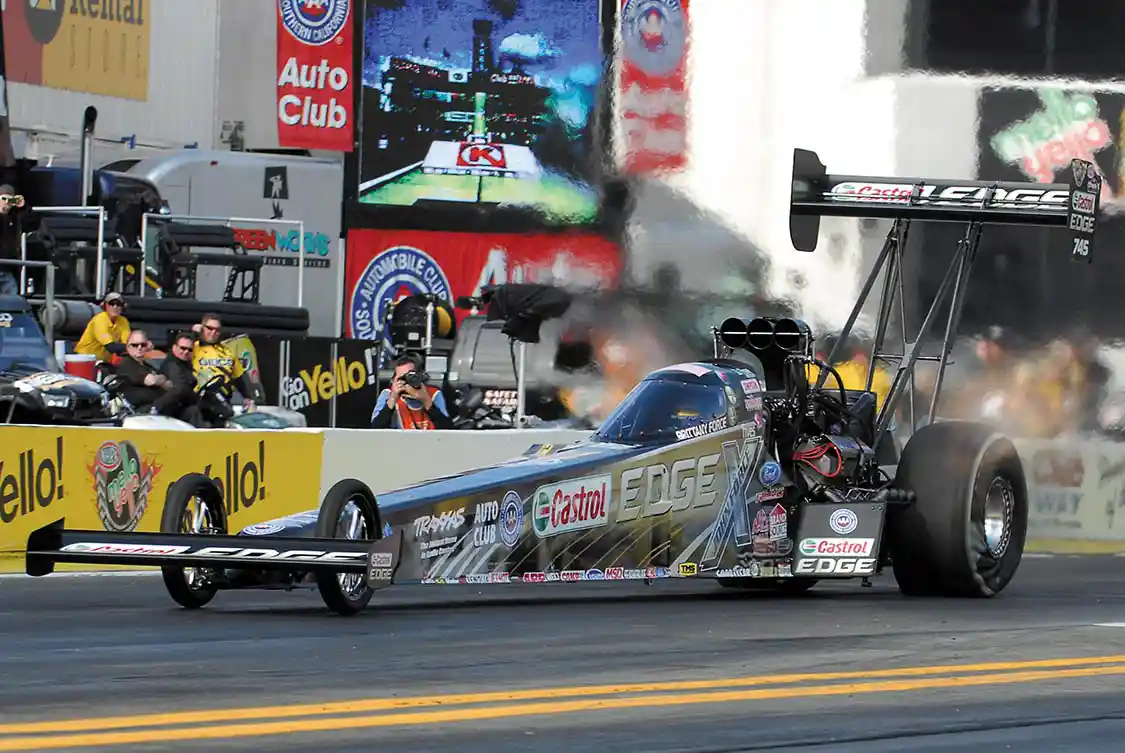
The John Force Racing team uses titanium in similar ways for their Funny Cars and Dragsters. “We primarily use titanium in the clutch components, bell housing, pressure plate and cover, flywheel, some chassis components—basically we use it wherever we can to conserve weight and still have a high degree of strength,” Medlen explains. Medlen has rejoined the organization, working with JFR from within The Eric Medlen Project, a research and safety initiative founded in 2007 by John Force, located in the team’s Brownsburg, Indiana facility. Given Medlen’s position in The Eric Medlen project, he has become the “safety conscience” of the organization. Formula DRIFT is another venue where an abundance of titanium is used. Nate Haugh, chief engineer and lead fabricator for Bink Industries, works closely with Formula DRIFT professional racer Joon Maeng, and has incorporated titanium into Maeng’s Lucas Oil, MavTv, Rayno Film S13 car. “The most useful application of titanium for us is the bash bars. We are able to shave off weight outside of the wheelbase and still have full protection for the driver and chassis, without compromise in design because of weight.”
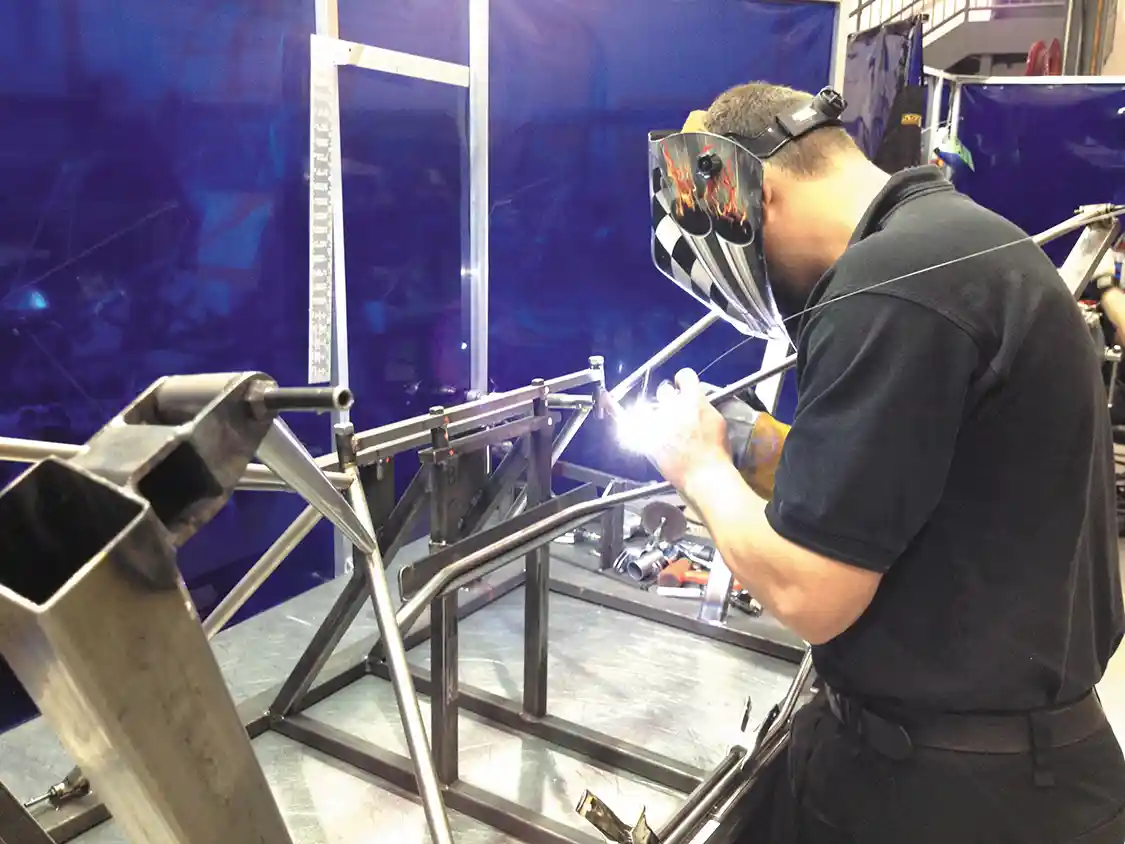
Considering the amount of contact drift cars are subject to while sliding in tandem with other drivers just inches from walls, titanium helps protect the frame of the chassis in the event of a crash. “We use titanium in drifting because we need a lot protection for the frame, motor and other engine vitals. Titanium provides a good crush element for the front and rear of the car. It also is used in hanging body panels, intercoolers and used for firewalls to separate the driver from radiator and oil lines,” explains Haugh. These crush elements are so effective, in one instance it actually saved the car from being totaled. Other materials could have been used and they may have saved the car as well, but not without sacrificing the major weight savings that titanium offers. “I love the advantage of using titanium in drifting and only see continued use by more teams as time goes on.” The overall properties of titanium make it a wonder metal. An intriguing benefit of titanium is that it’s able to fix itself. Todd Harrison, president of TMS Titanium explains: “The reason that titanium is ultra-corrosion resistant is because it forms an oxide layer over its surface to fight off contaminates. If this surface is damaged, the oxide layer actually repairs itself.” Titanium can also be welded, but not to anything other than titanium. It’s a reactive metal, if it’s exposed to the atmosphere at an elevated temperature, it will absorb the oxygen from the atmosphere and weaken the welded area. There are several common ways to keep out the oxygen, such as welding in an enclosed space purged with argon, or purging the inside of the tube and trailing the torch with extra argon protection.

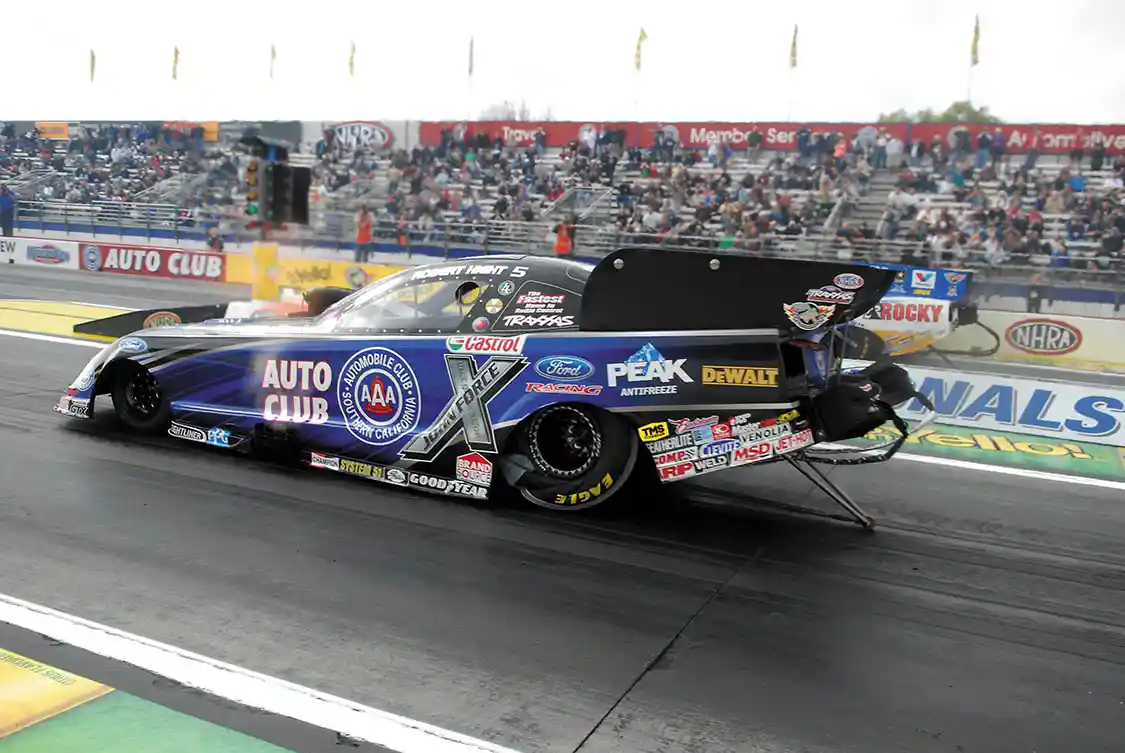
As one of the early adopters of titanium, John Force Racing’s two-time world championship Crew Chief Mike Neff sees the continued value of the metal: “We’ve been using titanium for many years, and as time goes on, we see it being used more and more in the racing industry. Yes, it is more expensive, but it’s worth it because it holds up longer.” Neff is the crew chief for Robert Hight, JFR president and driver of the Auto Club of Southern California Ford Mustang Funny Car.
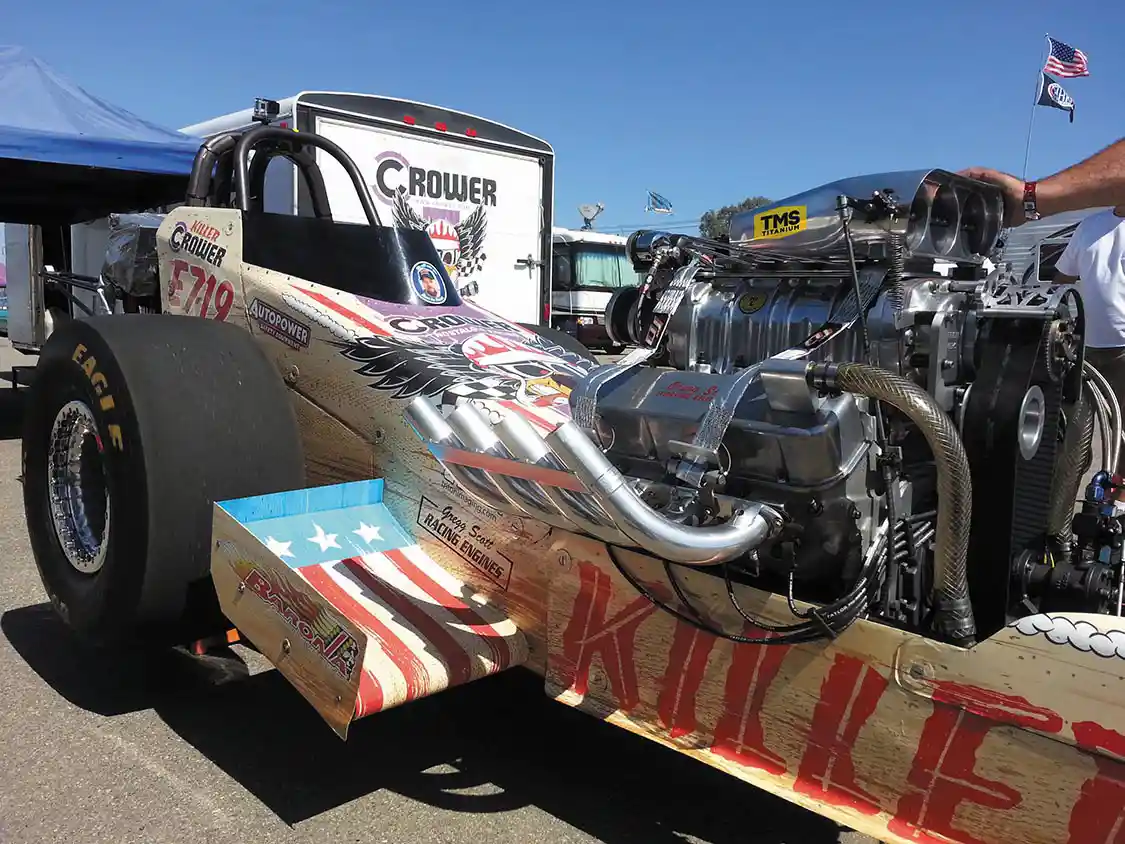
Bruce Crower, mastermind behind Crower Cam and Equipment, started using titanium more than 40 years ago and has been employing it ever since, mainly through connecting rods. “We use titanium because it is 40% lighter than steel but still matches the strength. Titanium has an amazing power-to-weight ratio, and is really the perfect element for creating the ultimate race car.” A force to be reckoned with since the ’50s, Crower’s engineering genius has grown into not only a substantial enterprise, but has resulted in the creation of the Crower Cup series. The 2014 Crower Cup series was be held last summer at The Barona Drag Strip in Lakeside, California.
NASCAR teams use titanium in areas where the rules permit, which are very limited, allowing only small items such as intake valves. Indy Car is another series where titanium is allowed, but once again, only in very limited areas. Here teams find ways to work with titanium, mostly using it in specific assemblies. Sprint cars have the ability to use more titanium, and it’s employed in a lot of hardware as well as brake rotors and brackets.
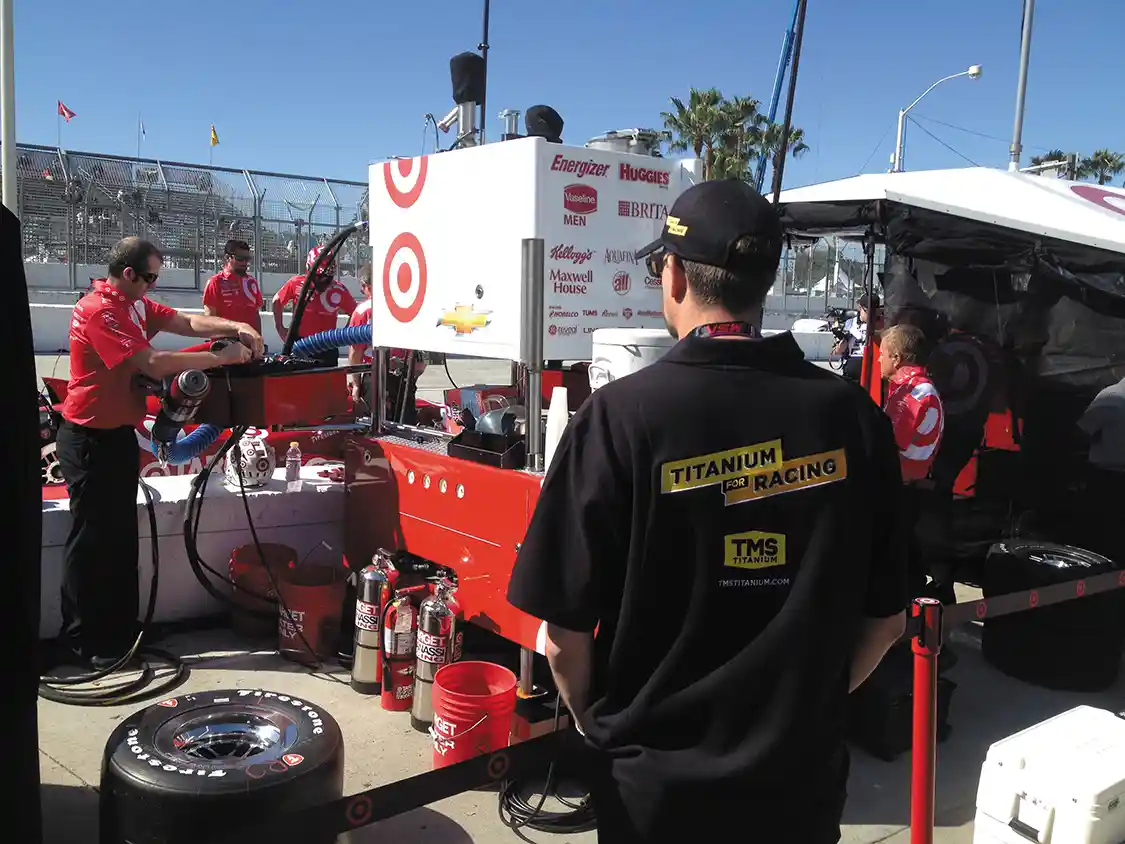
While the bigger players have to use their imagination, most race teams, despite size or budget, have one goal in mind: to save weight wherever possible. Titanium allows them to do this by shedding weight from the car and individual assemblies, thus affording engineers the opportunity to add it back in areas where they choose. The easiest way to incorporate titanium into a race car is hardware, because the metal is half the weight and similar in strength to the standard metals used. Additionally, the hardware is easy to change and provides a team immediate weight savings.
One of the main factors for titanium’s entrance into the racing world is the metal’s competition with steel and aluminum While the most common titanium grades used are just about the same strength as steel, titanium is 40% lighter and has better memory. When compared to aluminum, titanium is actually heavier, with the density of titanium being .163 lbs-in cubed, where the density of aluminum is .0975 lbs-in cubed (steel is .284 lbs-in cubed). The benefit that titanium has to offer over aluminum is strength. Titanium maintains its strength over a longer period of time, allowing the fabricator to use very thin material to accomplish the same task, whereas aluminum would have to be double the thickness for the required strength.

One way titanium is projected for use in the future is for fabrication, thanks to new machining and coating technologies proving to make titanium a more fabricator-friendly material. This advancement helps solve titanium’s age-old problem of being horribly galling in any situation where it rubs against anything, such as when it’s not bolted solid. Coating technology is quickly developing to improve this issue, and the answer for the future might be a combination of coatings: a first coating to improve the hardness of the titanium, and a second to improve lubricity.
Another area that’s being explored is the driveshaft, a piece that connects the transmission to the rear axle, which could benefit from flexibility and light weight resulting in increased driveshaft speed and efficiency. ALDriveline is using titanium in its driveshaft construction. This shaft is a great start, and in the future could be coupled with additional titanium parts.
Overall, titanium is used across a diverse range of industries and possesses many exceptional qualities and benefits. Although it’s been around for many years, new uses are being explored and limits are being pushed, showing that it has much potential for the future. The racing community has become an adapter of the metal and is consistently making new discoveries and improvements for exploiting titanium in a variety of parts, all with one goal in mind, to build the ultimate race car.

OBS Builders Guide
We’ve seen it. We’ve talked about it. And now, we’re going to dive deep into the world of electric motor-swapped RestoMods to show you what… Continue reading
Chris Hamilton . March 08, 2022

Feature Stories
Adam and Melissa’s Super 70’s Second Gen We all have those vehicles that blast us right back to our childhoods. Even with one quick glance,… Continue reading
John Mata Jr. . July 07, 2025

Events
Something for Everyone! Several important factors must align to really put the stamp on a great car show. An impressive lineup of vehicles ranging from… Continue reading
DAMIEN DAVIS . June 22, 2023

Feature Stories
Ruben Garcia’s Impactful F-150 Lightning In the world of Ford enthusiasts, one model reigns supreme: the 10th generation F-150. Among its most passionate fans is… Continue reading
Joe Greeves . August 08, 2025

Events
Modifying and Wheeling a New Generation of the Toyota Tundra Speed Metal is an automotive event dreamed up by Terra Crew partner James Holguin and… Continue reading
Evan Walsh . October 21, 2024

C10 Builders Guide
Legacy EV’s All-Electric ’71 C10 In a scene dominated by LS engine swaps, the custom truck community has very few attention-commanding motor upgrades, though the… Continue reading
John Mata Jr. . May 23, 2023


Super Run 2026 Classic Car Show
Super Run 2026 Classic Car Show Casablanca Resort 950 West Mesquite Blvd Mesquite, NV 89027
Concours D'Elegance
Cobble Beach Resort 221 McLeese Dr, Kemble, ON N0H 1S0
Charity Car Show
Mesa Marketplace 10550 E. Baseline Rd, Mesa , Az 85209
CHICO CONCOURS Car Show
Silver Dollar Fairgrounds 2357 Fair Street, Chico, CA 95928
Goodguys 33rd Summit Racing Lone Star Nationals
Texas Motor Speedway 3545 Lone Star Circle
We use cookies to enhance your browsing experience, serve personalized ads or content, and analyze our traffic. By clicking "Accept All", you consent to our use of cookies. Visit our Cookie Policy for more info.




 Please wait...
Share Link