










 Jeff Burk
.
June 11, 2026
.
Drag Racer
Jeff Burk
.
June 11, 2026
.
Drag Racer
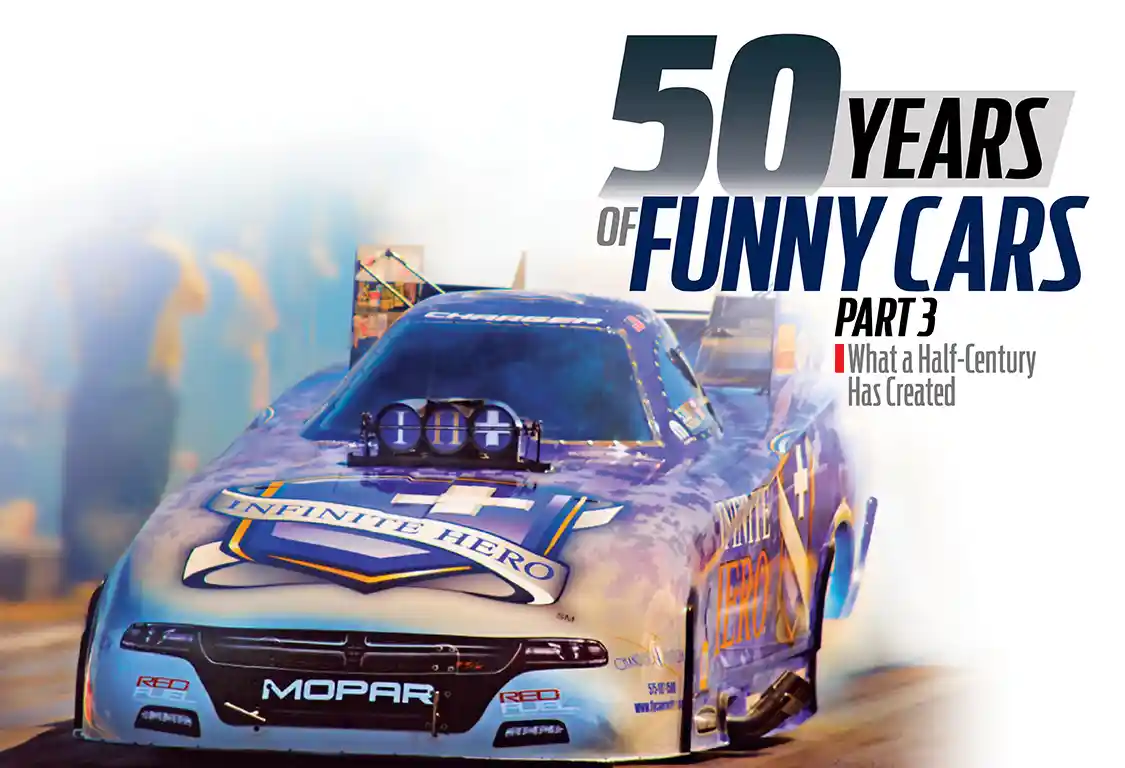
DRAG RACING FANS ARE CELEBRATING 50 YEARS OF NITRO FUNNY CARS THIS YEAR. To commemorate the golden anniversary of the class, virtually everyone in the media who covers the sport has compiled a top 10 list.
My assignment was to determine the best cars from three distinct timelines: 1987-96, 1997-2006 and 2007 to the present. To be fair to all teams and drivers, I decided the determining factors for ranking would be performance and race wins. After all, in sports, greatness is ultimately measured by performance and accomplishment.
The Funny Car class was altered in a dramatic and long-lasting way when Bernstein had salt flat streamliner racers, the Arivett brothers, build a very sleek Buick body, dubbed ‘Batmobile’ by the public and press.

Applying these criteria, the number-one driver for those three decades is fairly easy to identify: John Force. A variety of all-star tuners, starting with the legendary Austin Coil, followed by (in alphabetical order) Dean “Guido” Antonelli, Mike Neff, Jimmy Prock and Jon Schaffer, have tuned Force’s nitro Funny Cars to one or multiple NHRA Championships. As a matter of fact, Force personally won more than 50% of the NHRA Funny Car World Championships during this three-decade era, a feat unmatched by any other driver or team in major league motorsports history.
To be sure, there were other teams and drivers not driving for JFR that won NHRA national events, specialty races and world championships between 1987 and 2016, but none came close to the overall domination of the NHRA nitro Funny Car class from 1987 on by John Force Racing (JFR) and specifically Force.

In this 10-year period, Force won 67 of 203 NHRA National Events, four of nine Big Bud Shootout races and six NHRA World Championships. In 1996, Force and tuner/crew chief Coil had one of the more remarkable seasons in Funny Car history. That year there were 19 national events and Force went to the final round 16 times, winning 13, and had a round-win record of 65-6. Case closed. Force, with the legendary Coil and Bernie Fedderly tuning, was the best nitro Funny Car team in the world between 1987-96.
Despite Force’s dominance of those years there were other drivers and teams that were worthy opponents to his juggernaut. We are not listing these in any particular order. We’ll let readers make the call.

Kenny Bernstein and his tuner, Dale Armstrong, were major players in this era until Bernstein decided to move to Top Fuel after the 1989 season. Bernstein and Armstrong won four consecutive NHRA Funny Car Championships, including the years 1987-88. They won 25% of all FC races in those two years. One can only speculate how he would have impacted the current state of Funny Car competition if Bernstein hadn’t shifted his focus to TF.
Though Armstrong’s mechanical innovations were numerous, the team’s aerodynamic innovations were the most profound. The Funny Car class was altered in a dramatic and long-lasting way when Bernstein had salt flat streamliner racers, the Arivett brothers, build a very sleek Buick body, dubbed “Batmobile” by the public and press. For better or worse, depending on your point of view, today’s brand of ultra-aerodynamic 335-mph Funny Car bodies is the end result of Bernstein and Armstrong’s ’87 Buick LeSabre.

There are several other drivers and teams from that 10-year stretch that had hugely successful single seasons and are worth noting because these drivers and their crew chiefs kept Force and Coil from absolute domination. In 1989, Bruce Larson had one of the most impressive records for an East-Coast-based Funny Car team in drag racing history. Long-time match racer, Larson, and rookie and former Outlaw Sprint Car driver/tuner, Maynard Yingst, combined talents, and in 1989 won six events; plus, they were runner-up five times in their Sentry-backed Olds.
In 1992, Cruz Pedregon got the dream job of driving for potato baron Larry Minor. Minor had a multi-car nitro team with backing from McDonalds. That same year, Minor had John Medlen tuning and Cruz wheeling the red-and-yellow Olds. Force led the points chase most of the season, but at Brainerd, Minnesota, toward the end of the season, the Minor team went on an absolute tear, winning five straight NHRA National Events in a row, shoving Force to the curb and winning the championship.

Cruz Pedregon and Medlen were also the first NHRA Funny Car team to record an elapsed time in the 5.0 range.
Several other notables of the era were Roland Leong’s 1991 Hawaiian Punch Mopar, Al and Helen Hofmann, the Candies & Hughes FC and Tom McEwen’s ’57 Chevy.
Jim White drove for Leong in 1991. The team recorded the two fastest Funny Car speeds (290-plus) of the year, won four races (including the U.S. Nationals and the Big Bud Shootout) and finished second in the NHRA Funny Car Championship to Force.
The Hofmanns, along with tuner Tom Anderson, were the antithesis of the corporate button-down shirt racers. They were a throwback team to the early days of the sport when performance trumped everything. Al Hofmann was loud, brash, spoke his mind and obviously relished racing and beating better-financed teams. From 1991 to 1995, Hoffman won 11 national events, the 1991 Winston Invitational and the Big Bud Shootout in 1992, 1994 and 1995.

Finally, there is the IHRA representative. Although many tend to see the IHRA Funny Car program as a second string series, from the mid-’70s through the late-’80s, names including Ron Colson, Bernstein, Ed McCulloch, Raymond Beadle, Billy Meyer, Mark Oswald and Tom McEwen were regular IHRA competitors. Winning an IHRA Funny Car race was serious business.
Oswald and the Candies & Hughes team belong on this list just for the fact that in 1984 the team did something unequalled in drag racing history: They won both the NHRA and IHRA World Championships. In a five-year span between 1983-87, they won four IHRA Championships, including back-to-back wins in 1986-87. The team also went to the final round of the Big Bud Shootout during those two years, beating Force in the 1986 finals and losing to him in 1987.

Then there is the famous McCulloch/Fedderly team. McCulloch was the 1988 IHRA World Champ, the same year Billy Meyer owned the IHRA. McCulloch won six races, including both IHRA National Events at Meyer’s Texas Motorplex, which got him a $100,000 bonus that Meyer had posted for any nitro racer who won both races. An interesting side note is that Texan Eddie Hill also won both races in Top Fuel, securing a $100,000 bonus. Meyer sold the IHRA after that season.
Finally, there is McEwen and his famous ’57 Chevy nitro Funny Car. McEwen built and started racing the gorgeous car as an exhibition at NHRA events, but he was allowed to compete as a legal nitro Funny Car in IHRA competition.
While built to maintain its classic ’57 Chevy appearance and durability rather than for performance, it was by far the most well-known Funny Car of the era by casual fans. It appeared in virtually every car magazine then in existence. It is probably not a stretch of history or the truth to credit McEwen with the idea, and later the popularity, of today’s Nostalgia Funny Cars even though the body style wouldn’t be legal for the NHRA’s Heritage Series Nostalgia Funny Car.

This decade of Funny Car racing ushered in some brutal and expensive changes to nitro Funny Car. Major tobacco, beer and other corporate sponsorships came to the class. Multi-car teams and multiple tuners per car became the combination required to win championships. A single-car Funny Car team had a very slim chance of winning an NHRA World Championship.
Multi-car Funny Car teams dominated racing for the largest part of the decade. Force added driver Tony Pedregon, and then later Gary Densham and Eric Medlen, to his team.
Force, under the guidance of Coil and Fedderly, pushed the technology envelope during that period by hiring aerodynamic engineer Tim Gibson. Force’s domination was so complete that he was often accused by his peers of circumventing the rules. Once after a race when he’d been accused by Hofmann of concealing a traction control device in his suit, Force stripped down to his skivvies to prove he had nothing to hide.

Force won the NHRA Funny Car Championship 10 years in a row, a feat unmatched in major league sports of any kind. His streak started in 1993 and ended in 2002, including six straight championships between 1997 and 2002. Force also won the 2004 and 2006 Funny Car Championships. During that stretch of 10 years, JFR won nine championships, including one by Tony Pedregon. The only other driver or team to win an NHRA World Championship during that period was Gary Scelzi.
For the second straight decade, Force was the absolute dominant Funny Car racer/team owner, and no one else even came close. Between 1997 and 2006, Force entered 228 races, went to 105 final rounds and had 61 tour victories.
He also qualified for all 10 shootouts, winning two, the 2000 Big Bud Shootout and the 2006 Skoal Showdown. During that period, he had 10 laps that were either the quickest or fastest in history. Those numbers are the definition of domination!

While Force was running the decade, a case could be made that teammate Tony Pedregon was his equal. Tony and his crew chief/tuner, Medlen, were little short of spectacular. In just seven years together, the pair won 26 national events, a Big Bud Shootout and a world championship for JFR. Tony departed after the 2003 season.
Ron Capps was chosen by drag racing legend Don Prudhomme and later Don Schumacher to drive their fuel coupes. He was a threat at every race. The California racer won 20 national events, three Skoal Showdowns and finished second in the championship points chase three times, finishing second to Force twice and once to teammate Scelzi in 2005 when both drove for Schumacher.

Jack Beckman, driving for Don Schumacher Racing (DSR), also gets a nod for his then-quickest and fastest FC pass in history with a 4.662/333.66 effort at the 2006 Winternationals. Ten years later, Beckman and his crew chief Jimmy Prock would again secure their place in drag racing lore by making the fastest pass in 1,000-foot racing history at 333.25 mph at Chicago, which was more than 2-mph faster than any Top Fuel dragster.
Also worthy of note is Whit Bazemore, basically an indie racer who, like Gary Densham, was given an opportunity and won 20 national events between 1997-2006, including the U.S. Nationals.

During the years between 2007 and the present, the NHRA Funny Car class has experienced tectonic changes. The NHRA introduced rules that imposed a moratorium on technical advances, reduced the track length for nitro cars to 1,000 feet and restricted max-engine rpm.
The cost of fielding a team capable of competing for a championship, according to a consensus of team owners, is between $2.6 and $3 million per season. The use of carbon-fiber bodies, costing by some reports upwards of $70,000 each after adding tin and titanium, is but one example of the staggering expense. To some, these new bodies more closely resemble an endurance racing GTP car competing at the 24 Hours of Daytona or LeMans than anything rolling off an automaker’s assembly line.

Two mega-teams, DSR and Kalitta Motorsports, have dominated the class and won a majority of races and championships. Despite this fact, nitro Funny Car racing has never been more exciting, entertaining and competitive than it has been the last decade.
The two-decade era of JFR domination of the class came to an end at the conclusion of the 2006 season. Between 2007 and 2015, JFR and DSR each won three NHRA Funny Car World Championships. The Pedregon brothers, Tony and Cruz, did break through with a couple of wins in 2007 and 2008.
This current era of nitro Funny Car racing finds the multi-car team operating as a single entity with all teams sharing tune-ups, testing and parts development with crew chiefs and other team members who seem to be changing camps constantly. Other than Force, this class has few full- time old-school drivers or teams actively competing. Jim Dunn, Tim Wilkerson and Cruz Pedregon are seemingly the only full-time single-car teams left.

So, the task of picking the single outstanding Funny Car driver and team of this 10-year period is difficult at best. But that is the deciding factor of this story, so here goes.
My pick for the best car and driver for this decade is DSR’s Matt Hagan and his tuner, Texan Dickie Venables. Since his NHRA rookie year in 2008, Hagan and Venables have won two NHRA Championships (twice finishing second in the points chase) and notched 22 national event wins. They were the first to break the four-second barrier for 1,000-foot racing with a 3.995 in 2011, the first to record an ET in the 3.80 range in 2015, and currently hold both ends of the national record at 3.862/335.57.
How impressive is Hagan’s record? He won 22 national events and two world championships in just nine years. By contrast, it took Force 20 years to win 19 national events and two world championships.

While Force isn’t the dominant player he once was, he remains at or near the top. Case in point: He was the only other driver to win two world championships during this period and also won 21 national events. But the edge goes to the DSR car and Matt Hagan for performance.
Beckman deservedly merits consideration. He and ex-Force crew chief Prock have been the fastest car in the class for some time by regularly recording speeds faster than 330 mph. Prock’s R&D with headers alone changed the face of nitro racing, and as a result, Funny Cars routinely go faster than the former Kings of Speed, Top Fuel dragsters.
Beckman won the 2012 NHRA Funny Car Championship with Rahn Tobler tuning and runnered-up twice. Throughout this period, Beckman has amassed 23 national event victories.
Certainly championship seasons from Robert Hight, Del Worsham and the Pedregon brothers make them among the best of the decade. But the numbers for the best of the best speak for themselves. Fire the next pair!
Why and How Nitro Funny Car Tuners Have Dramatically Increased Performance
Whether anyone likes it or not, nitro Funnycars, onaverage, arenowfasterthan Top Fuelers.
The dragsters remain significantly quicker than the floppers, but they can no longer claim the title Kings of Speed. The fastest 1,000-foot pass for a Funny Car so far in 2016 is 335-plus, and the fastest dragster clocking is 333-plus.
What caused this shift in performance for the Funny Cars, and why aren’t the Top Fuel cars going faster?
Drag racers have known since the early-’60s that one relatively inexpensive way for their cars to make more power is better exhaust header design. Top Fuel racers discovered that upswept headers blowing over the rear tires would improve performance and add downforce. Racing historian Dave Wallace Jr. contends that the first 200-mph Top Fuel dragster pass (not by Chris Karamesines) came about in part by the use of zoomie headers by West-Coast-based cars.

Hall-of-fame tuner Austin Coil has long known that each zoomie header on a nitro motor creates actual “thrust,” which is the generic term for the power a jet engine delivers. In the case of current nitro Funny Car engines, the consensus is each header pipe delivers about 500 pounds of thrust or 2,000 pounds of thrust per cylinder head.
Coil said that one of the biggest drawbacks to making more power with nitro motors was the headers. “The exhaust air has to make a 90- degree turn at the bottom,” Coil explained. “The engine is an air pump, and anything that restricts air flow is bad.”
With the laid-back headers Funny Cars are now using, the sharp, almost 90-degree turn the air had to make in the old design is significantly reduced, which converts to more power in the engine.
For years, Funny Car headers have been pretty generic. Header upsweep and construction were nearly identical. Getting the body to sit over the headers for some racers was an issue until the headers became more uniform.
The story goes that at this year’s Winternationals Jimmy Prock, Jack Beckman’s crew chief, had headers built with the individual pipes laid back further than was then the norm, and the results were instantaneous. Instead of providing the downforce through thrust, the headers on the Don Schumacher Racing cars were pushing the car forward. The effect was that the Funny Cars were leaving the line better and going faster at every track increment.
In short order, every nitro Funny Car and Top Fuel team was building new headers that were more backswept, sometimes larger or smaller in diameter, and in different lengths. There was a significant increase in the average speed for nitro Funny Cars.
In the end, NHRA rules and engineering limitations have slowed mass prototyping of headers. The only apparent downside to the new header design is that without the downforce that headers once provided, the cars have become much harder for drivers to handle from the 330-foot mark on.
Interestingly, at least one team tuner, Cruz Pedregon, is experimenting with headers where some of the pipes are in the stock location and the rest are pointed towards the rear of the car.
So why have the headers been such a benefit to the Funny Cars while the dragsters aren’t getting any performance benefit? Funny Car bodies by themselves provide an enormous amount of downforce, and Top Fuelers depend upon their front and rear wings, and importantly, the engine headers are absolutely necessary to provide downforce to be competitive and safe. In addition to losing critical downforce, if the Top Fuel teams tilt the headers back any more than standard, the flames burn the rear wing badly. From what Top Fuel tuners tell me, they are stuck with the header design they have.
While headers were the spark that started the current Funny Car performance binge, they aren’t solely responsible. One thing Funny Car teams have been able to do to go faster than their dragster brethren is to dial out some of the downforce the body generates with adjustments to the rear spoiler.
Alcohol Funny Car and Nostalgia nitro Funny Car racers discovered having a dump-truck-style spoiler on their cars didn’t make sense. Their alky and nitro engines simply aren’t making enough power to require a massive rear spoiler. Alky floppers quit using them 15-20 years ago. According to crew chiefs I’ve talked with and demonstrated by photos of the new Mustang, Camaro and Toyota nitro FC bodies, the spoilers are a fraction of the size and height they once were.
One tuner gave at least partial credit to both the Goodyear Tire Company and the NHRA track prep crew. He told Drag Racer that track prep is much better and more uniform from track to track, and the new tire design works much better than its predecessor.
You can expect nitro Funny Cars to continue dominating the speed charts unless new rules are implemented. As for the Top Fuel teams, they are stuck in the 60s—3.60 ETs that is—and they retain the title of Quickest Car in the World, which isn’t too bad a deal. After all, ETs win races, not speed.

Chevrolet
Triple Turbos, 1,200 RWHP, And 10-Second Time-Slips The story of Matt Misner’s Duramax-powered Chevy starts out like many others, with a mildly modified street truck… Continue reading
Jason Sands Jason Sands . September 10, 2026
F Series Builders Guide
FOR IMMEDIATE RELEASE Date: August 7, 2023 F-100 Builders Guide Transitions to F-Series Builders Guide: Embracing the Full Spectrum of F-Series Trucks [DURHAM, NORTH CAROLINA]… Continue reading
Nicole Hamilton . August 15, 2023
Feature Stories
AS SEEN IN OUR DIESEL WORLD MAY 2026 ISSUE – Buy Now! Greg Herren’s 1969 International Harvester Scout 800A Greg Herren has been building cars… Continue reading
JON DANIELS . June 02, 2026
C10 Builders Guide
A drive-anywhere, money-green, neck-breaking street machine Trucks. They’ve been America’s workhorse for decades being put through the ringer to get the job done. From hauling… Continue reading
Travis Noack . March 06, 2026
Diesel World
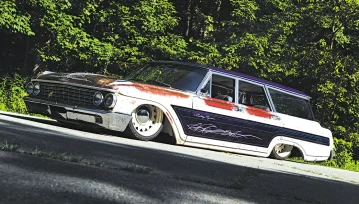
Kodie’s 6L Powered ’62 Ford Galaxie Country Squire Investing time and money on building a custom vehicle can be somewhat of a slippery slope. Depending… Continue reading
John Mata Jr. . January 02, 2024
C10 Builders Guide
AS SEEN IN OUR C10 BUILDERS GUIDE SUMMER 2026 ISSUE – Buy Now! Showing Up in a BIG Way For as long as I can… Continue reading
Cameron Webster . April 30, 2026


Super Run 2026 Classic Car Show
Super Run 2026 Classic Car Show Casablanca Resort 950 West Mesquite Blvd Mesquite, NV 89027
Concours D'Elegance
Cobble Beach Resort 221 McLeese Dr, Kemble, ON N0H 1S0
Charity Car Show
Mesa Marketplace 10550 E. Baseline Rd, Mesa , Az 85209
CHICO CONCOURS Car Show
Silver Dollar Fairgrounds 2357 Fair Street, Chico, CA 95928
Goodguys 33rd Summit Racing Lone Star Nationals
Texas Motor Speedway 3545 Lone Star Circle
We use cookies to enhance your browsing experience, serve personalized ads or content, and analyze our traffic. By clicking "Accept All", you consent to our use of cookies. Visit our Cookie Policy for more info.



 Please wait...
Share Link